Law student CV examples & templates to land a job
Launch your legal career with confidence. Build a professional law student CV that showcases your skills and secures more interviews today.

- Our customers have been hired by : *Foot Note
In legal applications, small details matter. A well-written law student CV can be the difference between securing an interview and being denied a life-changing opportunity. From structuring your education to highlighting legal skills and experience, this guide walks you through how to create a CV for law students that reflects the standards of the legal profession.
In this article, you’ll find:
- Law student CV examples tailored to internships, training contracts, and entry-level legal roles
- Professionally designed law student CV templates
- Key skills to include on a law student CV
- Step-by-step guidance on structuring and writing each CV section.
Smarter writing with built-in AI
Get instant, high-quality text suggestions tailored to your specific industry.
SEARCH ALL CV EXAMPLES
Law student CV example

Emily Carter
London, UK
emily.carter@contactmail.com
+44 7700 900123
linkedin.com/in/emilycarterlaw123
Personal profile
Law student in the final year of an LLB at the University of Bristol, with a strong academic focus on contract and commercial law. Achieved a First in Legal Research and completed over 50 hours of pro bono work supporting clients with housing disputes. Seeking a summer legal internship at Smith’s LP to apply strong research, writing, and analytical skills in practice.
Education
LLB Law
University of Bristol, Bristol, UK
Expected Graduation: June 2026
Predicted First Class
- Studied core and advanced modules including Contract Law, Tort Law, Commercial Law, EU Law, and Equity and Trusts
- Completed a dissertation titled “The Enforceability of Smart Contracts under English Contract Law”, analysing case law and statutory uncertainty in emerging technologies
- Participated in university mooting competitions, preparing written submissions and delivering oral arguments
- Achieved a First-class grade in Legal Research and Writing
- Awarded the Faculty of Law Academic Merit Scholarship (2023)
Legal experience
Legal Intern
Thompson & Reed Solicitors, Bristol
June 2024–August 2024
- Conducted legal research on contract and consumer law issues, supporting 15+ active client matters across the department.
- Drafted 30+ case summaries and legal notes, contributing to document preparation for client meetings and hearings.
- Observed client consultations and court proceedings, gaining insight into professional conduct and case preparation.
- Managed confidential files for 20+ clients, ensuring full compliance with data protection requirements.
Key skills
- Legal research – Conducted case law and statutory research during a summer legal internship, supporting solicitors across 15+ active matters.
- Written legal analysis – Achieved First-class grades in Legal Research and Writing through structured arguments and precise use of authority.
- Attention to detail – Reviewed and summarised legal documents and client files with a consistent focus on accuracy and compliance.
- Client communication – Supported client-facing work during a pro bono housing clinic, explaining legal processes clearly and professionally.
- Time management – Balanced full-time legal studies with 20+ hours of paid work per week while meeting all academic deadlines.
- Professional ethics – Handled confidential information in both academic and workplace settings, adhering to data protection and ethical standards.
Mooting and Debating
- Competed in university mooting competitions, preparing written submissions and delivering oral arguments before panel judges.
Pro Bono Experience
- Volunteer, University Law Clinic – supported clients with housing and benefits queries under solicitor supervision.
Professional Memberships
- Student Member, The Law Society of England and Wales.
Law student CV templates
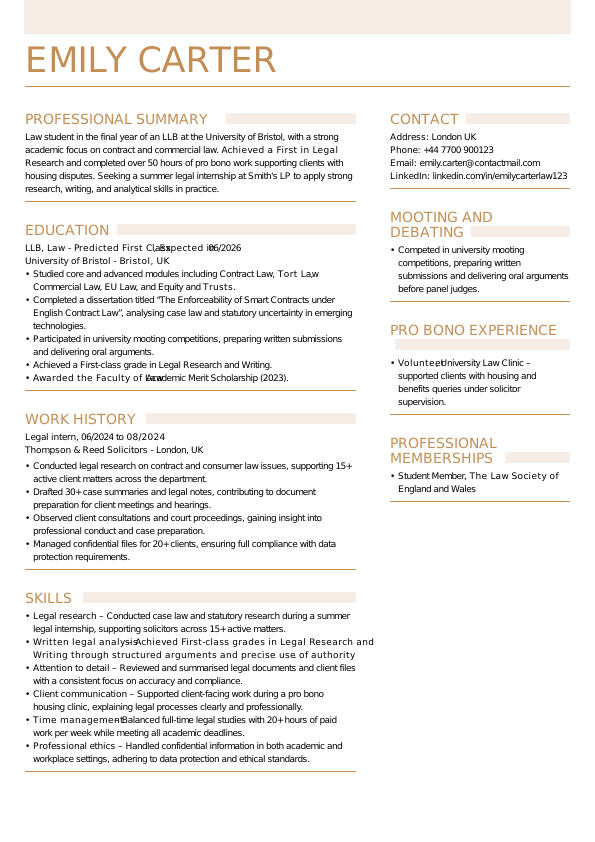
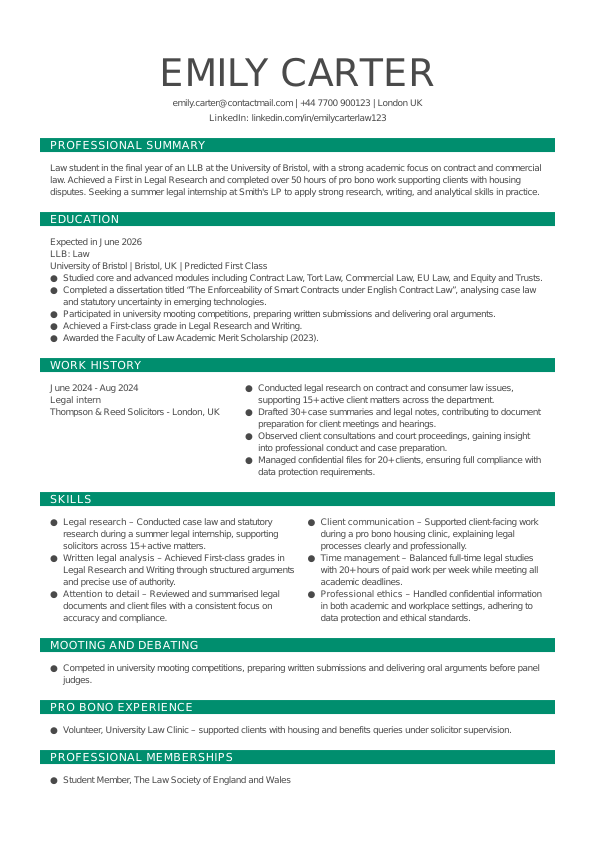
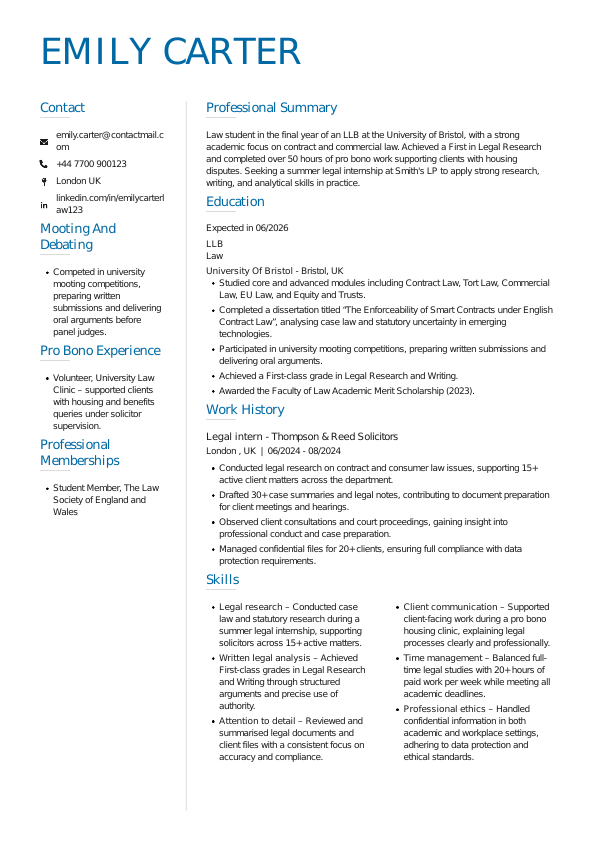
Choosing from MyPerfectCV’s law student CV templates helps you present your academic background and early legal experience with clarity. Select a UK CV template that suits your stage of education and tailor it easily for internships, mini-pupillages, pro-bono opportunities, jobs, or training contract applications.
Choose the proper format for your law student CV
Before you start writing, it’s important to choose a CV format that reflects where you are in your legal journey. British CVs usually follow one of these two formats:
Reverse-chronological law student CV format
The reverse-chronological CV is the most commonly used format in the legal profession. It highlights recent education and experience first, allowing recruiters to quickly assess relevance and progression.
It’s the best choice for law students with work experience in law. Use it if you’ve completed:
- Legal internships or placements
- Mini-pupillages or vacation schemes
- Law clinic or pro bono work
- Paralegal or legal assistant roles
If you choose this format, follow this order of sections:
- Contact details
- CV personal profile
- Education
- Legal and work experience
- Key skills
- Bonus sections (mooting, publications, memberships, languages)
Skills-based law student CV format
A skills-based CV places emphasis on transferable and legal skills rather than job titles. It’s a strong option for early-stage students who are writing a CV with no work experience.
Choose this format if you:
- Are in your first or second year of law
- Haven’t yet secured legal placements
- Are transitioning into law from another discipline
- Need to downplay limited or unrelated work experience
- Have gaps in your career you want to hide.
Recommended section order for this format:
- Contact details
- CV profile
- Core competencies (key skills with evidence)
- Education
- Work experience (brief, without long lists of accomplishments)
- Bonus sections (mooting, interests, languages, memberships)
How to write a law student CV
Most law students worry they don’t have enough on their CVs yet. However, legal recruiters aren’t looking for finished lawyers, but for law students with potential.
Now I’ll explain how to present your education, skills, and early experience on a law student CV in a way that feels honest, professional, and well-judged.
Provide contact details on your law student CV
Law firms and chambers expect accuracy, restraint, and professionalism from the very first line. This section should make it easy to identify and contact you.
Place your contact details at the start of your CV. Avoid decorative elements or unnecessary personal information such as your date of birth or full home address. Also, don’t include a photo on your CV.
Provide the following details on the law student CV:
- Full name (as it appears on academic records)
- City and country (full address is not required)
- Professional email address
- Phone number with country code if applying internationally
- LinkedIn profile or professional website link (optional)
Law student CV example: contact details
Emily Carter
London, UK
emily.carter@contactmail.com
+44 7700 900123
linkedin.com/in/emilycarterlaw123
Write a strong law student CV profile
The CV personal profile is a short, tailored introduction to your application. Legal recruiters use this section to quickly understand who you are, what stage you’re at, and what kind of legal work you’re aiming for.
Keep your profile to 3–4 sentences. Your law student CV profile should include:
- Your current status (law student, year of study, or recent graduate)
- Degree and university
- Legal interests or intended practice areas
- One concrete achievement and a few of your strongest skills
- Realistic aim (e.g. internship, pupillage, training contract).
Law student CV profile example
Law student in the final year of an LLB at the University of Bristol, with a strong academic focus on contract and commercial law. Achieved a First in Legal Research and completed over 50 hours of pro bono work supporting clients with housing disputes. Seeking a summer legal internship at Smith’s LP to apply strong research, writing, and analytical skills in practice.
Focus on your legal education
For law students, the education section carries more weight than any other part of the CV. It is where legal recruiters assess your academic discipline and readiness for professional training. This section should demonstrate how you have engaged with the study of law.
Place the education section directly after your law student CV profile unless you already have substantial legal experience (or are making a skills-based CV).
Your law student CV education section should include your degree, institution, and study dates, followed by carefully selected academic details that support your application. This may include relevant law modules, research work, coursework, mooting, and other academically grounded extracurriculars that demonstrate legal skills in action.
You can strengthen your education section by including:
- Relevant law modules that align with the role or practice area you’re applying for (for example, commercial law, criminal law, or public law).
- Academic coursework or research projects that involved legal analysis, case law interpretation, or statutory application.
- Dissertation or extended research topics, with a short explanation of the legal issue addressed.
- Mooting, debating, or advocacy competitions connected to your studies.
- Academic awards, scholarships, or prizes that reflect strong performance.
These details help bridge the gap between theory and practice, especially if you have limited legal work experience.
Law student CV example: education section
LLB Law
University of Bristol, Bristol, UK
Expected Graduation: June 2026
Predicted First Class
- Studied core and advanced modules including Contract Law, Tort Law, Commercial Law, EU Law, and Equity and Trusts
- Completed a dissertation titled “The Enforceability of Smart Contracts under English Contract Law”, analysing case law and statutory uncertainty in emerging technologies
- Participated in university mooting competitions, preparing written submissions and delivering oral arguments
- Achieved a First-class grade in Legal Research and Writing
- Awarded the Faculty of Law Academic Merit Scholarship (2023)
Feature legal and work experience
The legal experience section shows how you’ve applied your academic knowledge in practical settings. Since you’re still a student, it’s possible you may not have held any paid legal positions. But, even if you have not held a full-time legal position just yet, you might have other forms of law work experience.
Legal experience on a law student CV can include:
- Internships at law firms or in-house legal teams
- Mini-pupillages or vacation schemes
- Law clinic or pro bono work
- Paralegal or legal assistant roles
- Court marshalling or shadowing barristers
- Voluntary roles involving legal research or client support
Structure each entry in the following way:
- Job title
- Organisation name and location
- Dates (month and year)
- Bullet points describing what you did (preferably in the form of quantified accomplishments)
Start each bullet point with a clear action verb and focus on outcomes, not just duties. Where possible, use the STAR CV method (Situation, Task, Action, Result) to add substance, even if you can’t quantify results.
Work experience on a law student CV: legal experience example
Legal Intern
Thompson & Reed Solicitors, London
June 2024–August 2024
- Conducted legal research on contract and consumer law issues, supporting 15+ active client matters across the department.
- Drafted 30+ case summaries and legal notes, contributing to document preparation for client meetings and hearings.
- Observed client consultations and court proceedings, gaining insight into professional conduct and case preparation.
- Managed confidential files for 20+ clients, ensuring full compliance with data protection requirements.
If you have little or no legal experience, you can still include non-legal work, but frame it around transferable qualities such as communication skills, responsibility, confidentiality, and time management.
Work experience on a law student CV: non-legal experience example
Customer Service Assistant
Marks & Spencer, Bristol
September 2021–May 2023
- Handled 40+ customer interactions per shift, resolving complaints in line with company policy and service standards
- Maintained a 95% positive customer feedback score, demonstrating strong communication and problem-solving skills
- Balanced 20+ weekly working hours alongside full-time legal studies, meeting both academic and workplace deadlines
List vital legal skills
In a regular job CV, the skills section is usually just a list of keywords tailored to the job description. For a law student CV (especially one in a skills-based format), I recommend paying a bit more attention to this section.
Choose 6–8 curated skills that align closely with the role you’re applying for (you can find these skills in the job description). Each skill should be supported by a short explanation or example. Aim to provide a healthy mix of hard and soft skills.
Legal skills example for a law student CV
Core competencies
- Legal research – Conducted case law and statutory research during a summer legal internship, supporting solicitors across 15+ active matters.
- Written legal analysis – Achieved First-class grades in Legal Research and Writing through structured arguments and precise use of authority.
- Attention to detail – Reviewed and summarised legal documents and client files with a consistent focus on accuracy and compliance.
- Client communication – Supported client-facing work during a pro bono housing clinic, explaining legal processes clearly and professionally.
- Time management – Balanced full-time legal studies with 20+ hours of paid work per week while meeting all academic deadlines.
- Professional ethics – Handled confidential information in both academic and workplace settings, adhering to data protection and ethical standards.
Improve your law student CV with bonus sections
Bonus sections allow you to add depth to your law student CV without overcrowding the core sections. They show how you engage with law beyond lectures and exams.
You should only include bonus sections that add value. If a section doesn’t demonstrate legal interest, transferable skills, or academic engagement, it’s best left out. Common and effective bonus sections for a law student CV include:
- Mooting and debating – Demonstrates advocacy skills, legal reasoning, and confidence in oral argument. Include competitions, roles played, and outcomes where relevant.
- Pro bono and law clinics – Shows practical exposure to client work, legal research, and ethical responsibility.
- Publications and legal writing – Highlights strong written analysis through articles, blogs, or academic contributions.
- Professional memberships – Signals commitment to the legal profession, such as student membership in the Law Society or Inns of Court.
- Known foreign languages – Particularly valuable for international firms or practice areas involving cross-border work.
- Certifications and short courses – Adds weight if relevant (e.g. legal research tools, data protection, or advocacy workshops).
These sections are best placed at the end of your CV and should be formatted using concise bullet points rather than long paragraphs.
Law student CV example: bonus sections
Mooting and Debating
- Competed in university mooting competitions, preparing written submissions and delivering oral arguments before panel judges
Pro Bono Experience
- Volunteer, University Law Clinic – supported clients with housing and benefits queries under solicitor supervision
Professional Memberships
- Student Member, The Law Society of England and Wales
How to structure a law student CV
In legal applications, presentation matters almost as much as content. A well-structured law student CV signals attention to detail and respect for professional standards. Even strong academic CVs can be undermined by poor formatting or a cluttered layout.
Your law student CV should be easy to scan, logically ordered, and consistent throughout. Here are the rules to follow:
- CV length: For most law students, a CV should be one page long.
- Font choice: Use a traditional CV font such as Arial, Calibri, Times New Roman, or Garamond. Avoid decorative or modern fonts that distract from the content.
- Font size and spacing: Use a 10.5–12 point font size for body text, with slightly larger text for section headings. Maintain consistent spacing to ensure readability without wasting space.
- Margins and alignment: Standard 1-inch margins work best. Align text to the left and avoid justified text, which can create uneven spacing.
- Section order and consistency: Keep headings clear and formatting consistent across all sections. Use the same style for dates, job titles, and bullet points throughout the CV.
- ATS-friendly formatting: Avoid tables, graphics, icons, or text boxes. While law firms often review CVs manually, many still use applicant tracking systems, and a simple layout ensures compatibility.
- Proofreading and accuracy: Errors in spelling, grammar, or dates are particularly damaging in legal applications. Always proofread carefully and, if possible, ask someone else to review your CV.
Law student CV dos and don’ts
Place your education section near the top of the CV and academic achievements where appropriate.
Back up skills and strengths with examples from your studies or part-time roles.
Adjust modules, skills, and experience to reflect the practice area or role you’re applying for.
Use neutral wording and avoid exaggeration or informal phrasing.
Errors in spelling, grammar, or dates are especially damaging in legal applications.
Avoid adding age, date of birth, photographs, or personal interests unless they are directly relevant.
Phrases like “highly motivated” or “excellent communicator” add little without evidence.
A shorter, focused CV is more effective than one filled with unnecessary detail.
If you lack legal experience, strengthen your education and skills sections instead of padding your CV.
Stick to a clean, traditional layout that reflects professional legal standards.
FAQ: law student CV
Do I need a cover letter with my law student CV?
In most cases, yes. Law firms and chambers often expect a cover letter. A cover letter allows you to explain your motivation, link your academic interests to the role, and show written communication skills, which is something legal employers value highly.
How do I write a law student CV with no legal experience?
Focus on your education, academic work, and transferable skills. Highlight relevant law modules, research projects, mooting, and coursework that demonstrate legal thinking. You can also include part-time or voluntary work, framing it around skills like communication, organisational skills, and time management.
Should I include my grades on a law student CV?
On most occasions, you should omit mentioning your grades; include them only if they are especially strong. Include your overall grade (or predicted grade) and highlight high-scoring modules that are relevant to the role. If grades are still pending, state your current average or predicted classification clearly.
Can I use the same law student CV for every application?
You can use the same base CV, but you should tailor it for each application. Adjust your CV profile, skills section, and listed modules to reflect the role you’re applying for, as a targeted CV is much more effective than a generic one.
How do I tailor a law student CV for a training contract?
Focus on academic performance, legal research, and evidence of commitment to the firm’s practice areas. Highlight relevant modules, legal experience, and skills such as written analysis and attention to detail. Use the firm’s job description to guide which skills and experiences you prioritise.
Related Student CV Examples & Templates

Create your law student CV today
From tailored law student CV templates to role-specific examples, MyPerfectCV builder gives you everything you need to create a polished CV that meets the expectations of law firms, chambers, and legal recruiters.