
How to write a CV education section + top UK examples
Set yourself apart and land more interviews. Master your education-section-cv with our expert guide to showcase your qualifications and secure your dream role today.

Our customers have been hired by : *Foot Note
Writing the education section of your CV is easier than you think, but you first need to know what employers expect to see.
In this guide, you’ll learn how to write your degree on a CV, how to put GCSEs on a CV, and the best way to format your qualifications at any career stage. We’ll walk you through the process step by step, share clear education CV examples, and answer the most common questions about listing education on a CV.
Whether you’re a student, graduate, or experienced professional looking to refine your qualifications, this guide will help you create a polished CV education section that strengthens your application. Let’s get started.
Smarter writing with built-in AI
Get instant, high-quality text suggestions tailored to your specific industry.
What is the education section of a CV?
The education section of a CV is where you list the qualifications that show employers you meet the academic requirements for the role. This can include GCSEs, A levels, degrees, vocational training, and any other relevant courses. This CV section helps recruiters understand your educational background at a glance.
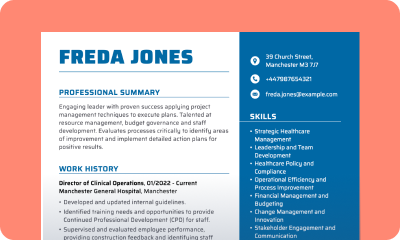
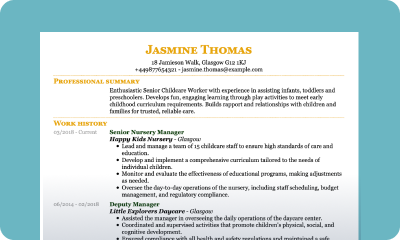
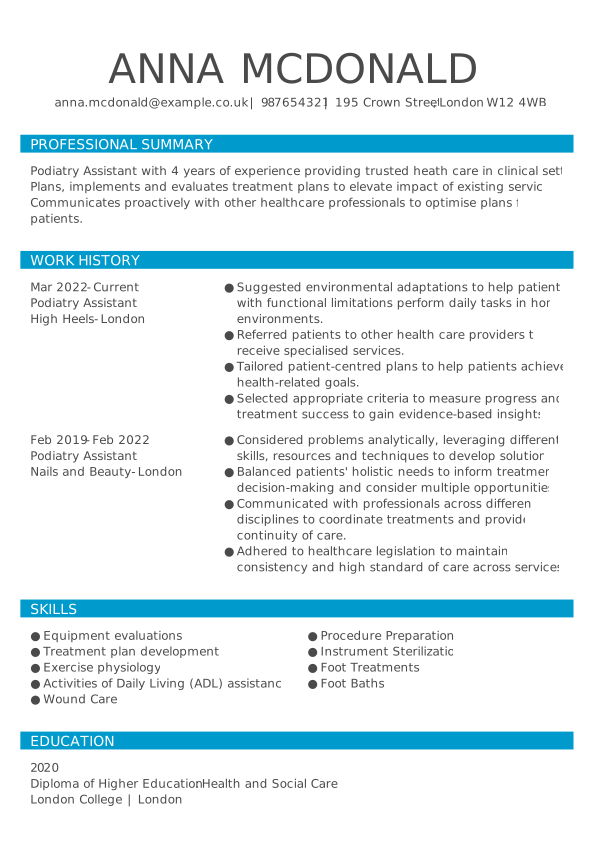
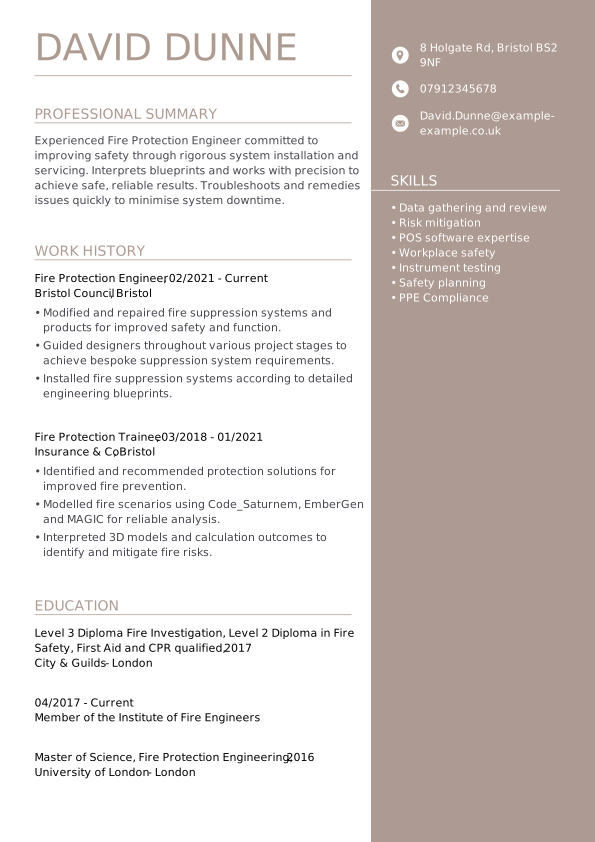
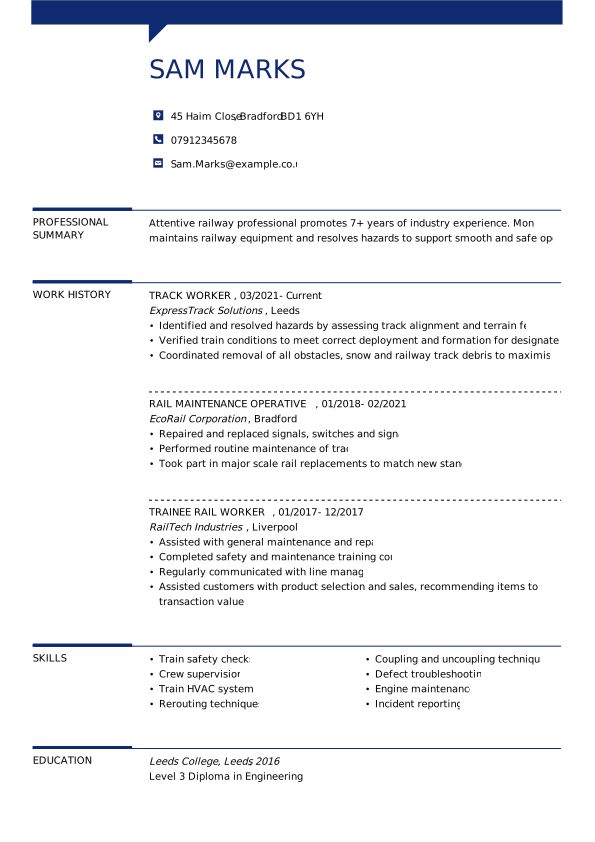
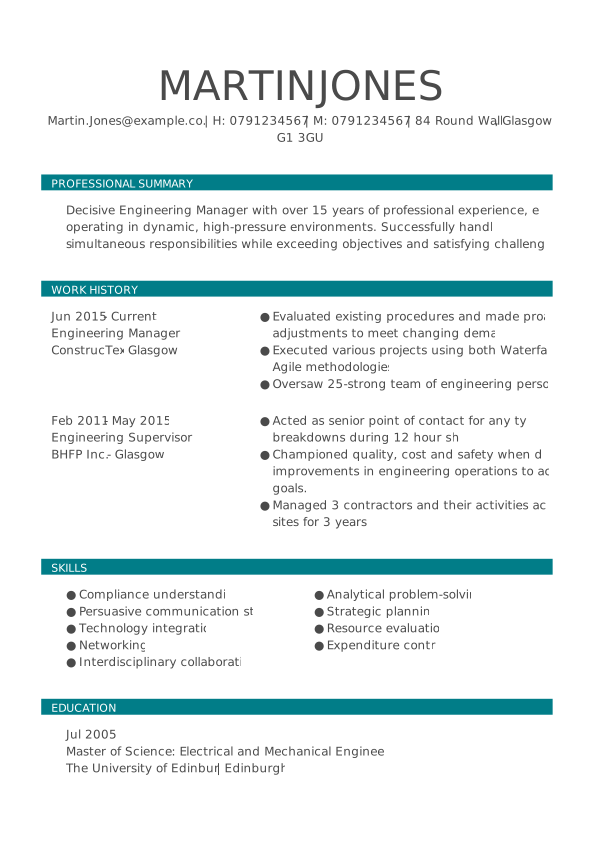
To see how a strong CV education section should look in practice, check out the three CV templates below. They show how different candidates present their qualifications in a clean, effective way.
How to write a CV education section
The goal here is to present your CV education accurately and in a clear format that recruiters expect. Use the steps below to structure your CV qualifications:
Name the educational institution awarding the qualification
Start by listing the school, college, university or training provider where you completed the qualification. While subjects and grades matter most, well-known institutions (like Oxford University) can strengthen your CV education section, so make sure this information is clear and accurate.
Note the study dates and subject title
Include your study dates (months + years) and the full course name or subject title. If you’re still completing the qualification, add “expected graduation date”. This helps employers understand your timeline and availability.
List the type of qualification
State the qualification level; for example, A levels, BTECs, NVQs, diplomas or degrees. The more recent the course, the more detail you should provide. Older qualifications can be summarised, and some (like GCSEs) can be omitted entirely if you hold higher-level degrees.
Highlight extracurricular activities and academic achievements
If relevant, add brief details that strengthen your application: key modules, a dissertation topic, academic awards, major projects, etc. These extras can help demonstrate specialist knowledge and motivation, especially for students and graduates. They are crucial when making a CV with no experience.
Where to put education on a CV
The right place for your CV education section depends mainly on your career level and the CV format you’re using:
Education placement by career level
If you’re a school leaver, student or recent graduate, your education is one of your strongest assets, so it should appear near the top of your CV, directly under your personal statement and before work experience.
This layout helps employers quickly see key information such as GCSEs, A levels, or a degree in progress, all of which often matter more than limited work history. Graduates with relevant internships can choose to place work experience first, but most early-career applicants benefit from leading with education, as it shows their academic strengths and subject knowledge upfront.
For early-career professionals with 1–3 years of experience, work history starts to matter more than education, but qualifications still carry weight. In this case, education belongs just below your work experience, remaining visible but no longer taking priority. Mid-career and senior professionals, however, should place their education towards the bottom of the CV, as employers focus far more on achievements, results, and job skills, rather than on degrees. At this stage, a brief line listing your degree, institution and dates is usually sufficient.
Education placement by CV format
In a reverse-chronological CV, the most common format, your education section should appear above work experience if you’re a student or recent graduate, and below work experience if you’re more experienced.
In a skills-based CV, used by career changers or people with minimal experience, education usually appears after the skills section but before work history. This allows your CV to display core abilities first while still giving your academic background proper visibility.
In an academic CV, education is central to the application, so it belongs near the top, often immediately after an academic profile and before research experience, publications or projects.
How to list all levels of education on a CV
Now that you know where the CV education section belongs, the next step is understanding how to format each qualification. Different levels of education call for different levels of detail, and choosing the right format can make your CV easier to read and far more impactful.
How to list GCSEs on a CV
When adding GCSEs on a CV, keep the format simple and easy to scan. Recruiters do not expect a full subject-by-subject breakdown. And you don’t want to artificially extend the length of your CV either.
Instead, summarise your GCSEs in two lines that highlight the total number of passes and key subjects like English and Maths. This keeps your CV education section tidy while still giving employers the information they need.
Instead of this:
Ten GCSEs: English (A), Maths (B), Science (C), History (B), Geography (A), IT (B), Business Studies (C), Music (C), PE (B), and Drama ©
Do this:
Example School, Town, Graduation date
- Ten GCSEs, including English and Maths
Example School, Town, Graduation date
- Ten GCSEs at grades A – C
Example School, Town, Graduation date
- Ten GCSEs at grades A – C, including English and Maths
How to list A-levels on a CV
A-levels sit above GCSEs in the UK education system, so employers expect slightly more detail when you list them on your CV. Unlike GCSEs, A-levels on a CV should be written out individually, as there are usually only three or four subjects and each one is more relevant to your academic profile, especially for entry-level roles, apprenticeships, university applications, or early-career CVs.
You should include:
- The institution where you completed your A-levels
- The dates you studied
- Each A-level subject and its grade
Suppose you took more than the typical number of subjects or completed AS levels alongside. In that case, you can still list them in your CV education section, but prioritise the ones most relevant to the job or course you’re applying for. Once you gain more work experience or complete a degree, this section can be shortened to save space.
A clear and effective way to list A-levels on a CV:
Greenfield Sixth Form College, Manchester
Graduated in 2021
- A levels: Maths (A), Economics (A), Business Studies (B)
How to list your university degree on a CV
The higher the qualification, the more relevant they become and the more information you should add. At a minimum, include:
- The degree title (e.g., BA, BSc, MA, MSc)
- The full course name
- The university name
- Your study dates (or “expected” if still studying)
If you’re early in your career, you can strengthen this section by adding bonus information in the form of bullet points. Consider things like:
- A degree classification (First, 2:1, etc.)
- Relevant modules that match the job or field
- Dissertation title or major research project
- Awards, scholarships, or academic honours
If you’re experienced, keep the education section on your CV brief by listing the qualification, institution, and dates only. Recruiters will be more focused on your work history.
Here’s a sample:
BSc Accounting & Finance
University of Leeds
September 2020 – June 2023
- Graduated with First-Class Honours.
- Relevant modules include: Corporate Finance, Financial Reporting, Audit & Assurance, and Econometrics.
- Dissertation: “The Influence of Automation on Audit Quality.”
How to list vocational qualifications, diplomas, and other qualifications on a CV
Not every qualification comes from school or university. Many roles, especially technical, hands-on, or industry-specific professions, value vocational training, diplomas, and certified courses just as highly. These qualifications can strengthen your CV education by showing practical ability, up-to-date knowledge, and commitment to developing specialist skills.
You should list these qualifications in the same structured way as academic ones, including:
- The name of the qualification (e.g., NVQ, BTEC, Diploma, Certificate)
- The level, if applicable (e.g., Level 2, Level 3, Level 5)
- The awarding body or training provider
- The completion date
- Your result or specialisation (optional)
If you’re applying to a role where technical skills or industry knowledge matter, these qualifications can carry more weight than any GCSEs, A-levels, or even university degrees. Place them prominently within your CV education section.
This is how you can list vocational or technical qualifications:
BTEC Level 3 Extended Diploma in Business
Manchester College
Completed July 2022
- Achieved Distinction overall with modules in Marketing, Finance, Project Management and Customer Behaviour.
For shorter training courses, such as first aid certificates, IT training, or industry-specific workshops, you can summarise them in a separate subsection under Education or move them to a Certifications & Training section later in the CV if you have multiple.
Just like this:
- First Aid at Work Certificate — St John Ambulance (January 2023)
- Sage 50cloud Accounting Training — CPD Certified (March 2022)
Why you should include education on a CV
Now you know where to place your education section and how to write your CV education section. But I still want to dispel one doubt that some people often have. Should I even include education on my CV?
While it’s true that companies will generally prioritise candidates with a strong work history and well-developed hard skills that help them excel at the role, education is far from useless. Here’s what your CV education section can do for you:

Lower your potential training costs
Candidates with qualifications typically require less training and less onboarding time, making them a more cost-effective, low-risk hire. This is because, through education, they’ve already gained some necessary knowledge, as well as problem-solving skills that help them deal with various troubles on their own. That’s a major advantage in busy or resource-limited organisations.
Give you a competitive edge over other candidates
When employers must choose between several candidates with similar work experience, the applicant with stronger or more relevant qualifications is far more likely to be shortlisted. If your job search has stalled, adding new certifications, CPD courses or specialist training can immediately strengthen your CV and broaden the roles you qualify for.
Help recruiters guide your CV to the right people
A well-structured CV education section also helps recruiters understand your strengths and level of expertise at a glance. This allows them to match you to roles that align with your qualifications and pass your CV directly to the most suitable hiring manager. In practice, this means faster responses.
Improve your chances of passing ATS checks
Finally, education helps your CV pass Applicant Tracking Systems (ATS), which many companies now rely on to filter applications. These systems scan your CV for essential keywords taken from the job description, often including qualification names, degree titles and technical certifications. Even highly qualified candidates can be rejected by ATS software simply because they didn’t list their credentials in the right format.
CV education examples
One of the easiest ways to nail your education section is by drawing inspiration from expert CV examples. Each one offers bundles of content and design ideas to impress the hiring manager and supercharge your CV.
Education section for entry-level candidates
Bristol College | September 2020 – July 2022
- 4 A levels: French (A), Spanish (B), English (A), and Economics (B)
Bristol High School | September 2015 – July 2020
- 10 GCSEs at grades A* – B, including French and Spanish
See more: Student CV
Education section for university graduates
BSc (Hons) Marketing
University of Manchester
September 2020 – June 2023
Grade: First-Class Honours
- Relevant modules: Digital Marketing Strategy, Consumer Behaviour, Market Research, Brand Management, Data Analytics for Marketing
- Dissertation: “The Impact of Personalisation on Online Consumer Trust in Retail Markets”
- Received the Dean’s Award for Academic Excellence (2022 & 2023)
- Led a 4-person team to develop a marketing campaign that increased engagement for a local charity by 38%
Read more: Graduate CV example
Education section for doctorates
PhD in Biomedical Engineering
Imperial College London
October 2019 – September 2023
- Thesis: “Nanostructured Biomaterials for Targeted Drug Delivery in Oncology”
- Developed a polymer-based nanoparticle system that improved drug delivery efficiency by 42% in pre-clinical testing
- Published 3 peer-reviewed papers in high-impact journals, including Biomedical Materials and Advanced Drug Delivery Reviews
- Presented findings at 5 international conferences, including the European Society for Biomaterials Annual Meeting
- Achievements: Awarded the EPSRC Doctoral Training Studentship
MSc Biomedical Sciences
King’s College London
September 2018 – September 2019
Grade: Distinction
- Key modules: Advanced Cell Biology, Molecular Pathology, Medical Imaging, Translational Medicine
BSc (Hons) Biochemistry
University of Bristol
September 2015 – June 2018
Grade: First-Class Honours
- Dissertation: “The Role of Protein Folding in Neurodegenerative Disease”
Education section for vocational qualifications
London Borough Council | August 2022
Health and Safety Certificate
Distance Learning Centre | September 2020 – July 2022
Level 2 Diploma in Health & Social Care
Essex College | September 2015 – July 2020
7 GCSEs, including English and Maths
FAQ: CV education section
How should I show my education if I’m still studying?
If you’re still completing a qualification, list it in your CV education section with your expected graduation date. Use a format like “BA English Literature (Expected June 2026)”. This shows employers exactly where you are in your studies and when you’ll be available for full-time work.
What should I do if I started a qualification but never completed it?
You can still list an incomplete qualification on your CV as long as you’re honest. Use wording like “Completed first year of BSc Biology” or “Studied 2021–2022”. Highlight any relevant modules or skills gained.
What should I do if I don’t have any qualifications?
If you have no formal qualifications, focus on work experience, skills, volunteering, apprenticeships, and on-the-job training instead. Many employers value practical experience just as much as academic credentials.
If you have no education or work experience, consider taking a specialist course relevant to your chosen industry. If you’re applying for a shop assistant position, you could study Retail Skills with City & Guilds. Similarly, countless management and leadership courses will make you a more attractive prospect to employers.
How often should I update my CV education section?
Update your CV education section whenever you complete a new qualification, finish a module, or gain a certification. Students and early-career applicants should review this section every few months; experienced professionals can update it as needed.
Is it okay to use abbreviations like BA/BSc on a CV?
Abbreviations such as BA, BSc, MA, MSc, MBA, NVQ, and GCSE are widely recognised by UK employers and perfectly acceptable on a CV. There is just one thing to keep in mind. If the job posting doesn’t use abbreviations, you also shouldn’t. There’s a chance some ATSs won’t understand the difference between a BA and a Bachelor of Arts.
Although this chance is relatively small, especially with the advancements in AI, it’s always better to stay safe than to miss opportunities due to avoidable mistakes.
How far back should my education history go?
You don’t need to go too far back in your CV education section. Most people only need to include their highest and most relevant qualifications. If you have a degree, there’s no need to list GCSEs in detail. Senior professionals can keep this section short by listing only their key academic credentials.
Should I list my primary school on a CV?
No. Primary school education should never appear on a CV. Start your education history with GCSEs (or equivalent) and move forward from there.
What if the job advert asks for qualifications I don’t have?
It’s usually not a complete dealbreaker. You can highlight transferable skills, relevant work experience, or alternative training that supports your application. If the qualification is essential (for example, a teaching or nursing licence), then you should pursue the required course before applying.
Key takeaways for writing the education section of a CV
Place your education section where it adds the most value
Students and recent graduates should put their education section near the top; experienced professionals should place it lower in the CV.
Focus on your highest and most relevant qualifications
You don’t need to list every course you’ve ever taken. Prioritise the credentials that matter most for the role and present yourself in the strongest light. Leave out anything that weakens your profile.
Use keywords from the job description
Match the employer’s wording (e.g., “RTPI-accredited degree,” “2:1 in Psychology”) to help your CV pass ATS checks, but only if you genuinely hold those qualifications.
Use a professional CV template for structure
A pre-made CV template ensures clean formatting and makes it easier to present your education clearly and professionally.
Always double-check your CV for errors
Typos and formatting mistakes can undermine even strong qualifications, so review your CV carefully or ask someone else to look it over.
Mariusz Wawrzyniak
Senior Content Writer
Mariusz is a career expert at My Perfect CV who writes practical, research-based guides that help professionals from all industries craft impactful CVs, write compelling cover letters, and advance their careers.
Related Content








*The names and logos of the companies referred to above are all trademarks of their respective holders. Unless specifically stated otherwise, such references are not intended to imply any affiliation or association with myperfectCV.