Getting into the London School of Economics and Political Science (LSE) is not an easy feat, and knowing when and how to use a CV can make all the difference.

If you’re applying for an undergraduate degree, you won’t need one, as UCAS applications rely on your personal statement instead. But for postgraduate and research programmes, a strong LSE CV is essential. In this LSE CV guide, you’ll find expert advice, tips, and LSE CV templates designed to help you stand out.

Pro Tip

Check out our other CV templates to boost your job search and create an application that truly helps you stand out to potential employers:

Do You Need a CV for LSE?

It depends on the level of study you’re applying for. The rules differ for undergraduate, postgraduate, and research programmes:

  • Undergraduate programmes (BSc degrees): You don’t need to submit an LSE CV. Applications are made through UCAS, where your personal statement, academic references, and grades are the main focus. LSE does not consider CVs at this stage.
  • Postgraduate taught programmes (MSc, LLM): An LSE CV is mandatory. Applications are submitted through LSE’s Graduate Admissions Portal, where you’ll need to upload a CV alongside transcripts, a statement of academic purpose, and references. Your CV here demonstrates both academic achievements and professional work experience.
  • Research programmes (MPhil/PhD): An LSE CV is again required, together with a detailed research proposal, transcripts, and references. At this level, your CV should highlight research skills, publications, academic awards, and relevant experience that prove your readiness for doctoral study.

In summary: CVs are not needed for undergraduate applications, but are essential for postgraduate and research applicants. Knowing this ensures you prepare the right documents and don’t waste time on materials LSE won’t accept.
What should an LSE CV format include?

An LSE CV is a bit different from a standard job application CV. Admissions tutors want to see a balance of academic achievement, research potential, and relevant professional or extracurricular experience. A strong Academic CV for LSE will highlight your readiness for advanced study and your fit with LSE’s rigorous standards.

Here are the essential sections to include in an LSE CV template:

STEP 1

Contact details

Make this the simplest part of your LSE CV. Clear contact details help them invite you to the next stage without hunting for information. You should always put your information close to the top of your LSE CV template. Include:

  • Full name – in a larger font (e.g., 16–18 pt) as your heading.
  • Professional email – firstname.lastname@… (avoid nicknames).
  • Phone number – use international format if you’re outside the UK: +44 7…
  • Location – city + country is enough (e.g., London, UK).
  • LinkedIn – if it’s up to date and matches your CV.

For an LSE CV, it’s also a good idea to add the following:

  • Academic profiles: Google Scholar, ORCID, ResearchGate (especially for MPhil/PhD).
  • Portfolio sites: GitHub/Kaggle (Data/CS), personal website with publications or projects.
  • Visa status (only if it clarifies eligibility; otherwise, leave it for forms).

You should avoid adding a photo to your CV for LSE. Other things to leave out include your date of birth, personal social media, multiple phone numbers, and national ID number.

STEP 2

Personal statement

Your personal profile is the opening section of your CV where you make your case for admission. Unlike a general job CV summary, this part must directly address LSE’s expectations: academic motivation, subject fit, evidence of achievement, and future ambitions. Keep it 80–120 words long and tailor every line to the chosen programme.

You should include:

  • Academic motivation – why this subject fascinates you and how your past study links to it.
  • Why LSE and this programme – specific modules, faculty research, or opportunities that drew you.
  • Your suitability – evidence of academic strength, relevant skills (research, analysis, teamwork), and honours/awards.
  • Forward-looking goals – how this MSc/LLM/PhD connects to your career or research ambitions.

Here are a few tips to make your LSE CV opening profile much better:

  • Avoid clichés (“I’ve always loved economics”). Replace with specific turning points (a dissertation, internship, award).
  • Show you’ve done your homework on LSE modules, professors, or research centres.
  • Keep it academic-first, with work experience as secondary evidence.

Unlike a standard, job CV, you can use first-person pronouns. You may even share a brief anecdote that made you interested in a specific program (“While researching [Subject] I came across a captivating piece written by [LSE Professor’s Name] which made me want to pursue my academic interests even further”).

LSE CV example—personal statement

My MSc dissertation on urban inequality, which earned a departmental prize, inspired my ambition to explore how housing policy shapes social stratification. LSE’s Department of Sociology, with its renowned faculty in urban studies, offers the ideal intellectual home for this research. My academic trajectory demonstrates strong preparation: a First in Sociology at the undergraduate level, a distinction at MSc, and published work in a peer-reviewed student journal. I am eager to contribute to the department’s seminar series and expand on themes of social justice and inequality. Beyond academia, I hope my research will inform urban policy initiatives in Europe, ensuring LSE’s rigorous training translates into real-world impact.

STEP 3

Education section

For an LSE postgraduate or research application, the education section is the backbone of your CV. Unlike a job CV, where education sometimes comes after work history, here it should appear directly after your personal profile. LSE admissions are primarily academic-focused, so this section must clearly demonstrate your intellectual preparation and achievements.

What to include on a CV for LSE applications:

  • Degree title, institution, and dates (start–end, including month and year).
  • Grades/expected classification (First, 2:1, Distinction, GPA equivalent).
  • Dissertation topic or thesis title (especially if it relates to the programme you’re applying for).
  • Relevant modules that align with your chosen LSE course (e.g., econometrics, international law, data analysis).
  • Academic awards, scholarships, or honours to strengthen credibility.

Place higher education first; include A-Levels only if they add value to the LSE CV. Emphasise coursework and dissertation that match the LSE programme.

LSE CV example—education section

BSc Economics
University of Warwick
Sept 2020 – June 2023 | First Class Honours

  • Awarded the Warwick Prize for Academic Excellence (Top 5% of cohort).
  • Dissertation: “The Impact of Green Investment on GDP Growth in Emerging Markets” (graded First).
  • Relevant modules: Econometrics II, Development Economics, International Trade Policy, Quantitative Research Methods.
  • President of the Economics Society (2022–23), organising 10+ guest lectures and research workshops.
  • Achieved an average of 75% in advanced statistical modules, demonstrating strong preparation for quantitative components of the MSc.

A-Levels: Mathematics (A), Economics (A), History (A)*
Sept 2018 – June 2020 | St. Paul’s College, London

  • Scored in the top 5% nationally in A-Level Economics.
STEP 4

Research Experience

For postgraduate and research applicants, this section is one of the most important parts of your CV. LSE values evidence of independent inquiry, critical thinking, problem-solving skills, and methodological rigour. Even if you don’t have formal published work yet, you can include dissertation projects, assistant roles, or independent studies that show your potential as a researcher.

Provide the following information on your LSE CV template:

  • Title of project/research – e.g., “Undergraduate Dissertation: The Impact of Monetary Policy on Housing Prices”.
  • Institution/organisation – State where the research was carried out.
  • Dates – Keep it precise (e.g., Sept 2023 – May 2024).
  • Description & outcomes – Highlight your research question, methods (quantitative, qualitative, mixed), and any measurable results, such as findings, citations, or presentations.
  • Collaboration – Note if you worked with a supervisor, lab, or team.

Be selective: only include research that’s relevant to your chosen programme. Emphasise methods (quantitative/qualitative/experimental) as LSE wants to see your technical skills in action.

If you have some conference presentations, working papers, or other valuable additions, you can mention them here. But do so only if you have very few of them. If, for example, you were a keynote speaker at 2 conferences, it’s better to write a separate section for them.

LSE CV example—research experience

Undergraduate Dissertation: “Foreign Direct Investment and Economic Growth in Sub-Saharan Africa”
University of Manchester | Sept 2023 – May 2024

  • Conducted econometric analysis using STATA on a 20-year panel dataset across 15 countries.
  • Identified significant correlation between infrastructure investment and GDP growth.
  • Awarded a First-Class mark (74%) and shortlisted for the university’s annual research showcase.

Research Assistant

Centre for Global Inequality
University of Manchester | Jan 2023 – Aug 2023

  • Supported a senior lecturer on a comparative study of income distribution policies in emerging economies.
  • Collected and cleaned data from World Bank and IMF databases.
  • Co-authored a literature review chapter used in a published policy paper.
STEP 5

Work experience

When applying to postgraduate or research programmes at LSE, your work experience doesn’t need to be long or extensive. The admissions team is looking at whether your experience, whether academic, professional, voluntary, or internships, demonstrates transferable skills.

Here’s how to write your work experience section:

  • State your role title, organisation, and dates (month + year).
  • Add 3–5 bullet points per role, focusing on tasks that link to research, analysis, leadership, or subject-specific skills.
  • Use action verbs (“analysed,” “developed,” “co-ordinated,” “evaluated”) to show impact.
  • Quantify achievements where possible (numbers, percentages, outcomes).

Prioritise quality over quantity. 2–3 strong roles are enough if they’re clearly relevant. If you lack formal work experience, highlight internships, academic projects, or voluntary roles.

LSE CV example—work experience

Research Intern
Institute for Fiscal Studies, London
June 2022 – Aug 2022

  • Conducted econometric analysis on UK housing affordability, using STATA and R to interpret large datasets.
  • Co-authored an internal briefing paper presented to senior economists and government advisors.
  • Summarised policy implications of findings, contributing to recommendations on affordable housing strategy.

Part-Time Data Analyst
Green Future Consulting, London
Sept 2021 – May 2022

  • Designed regression models evaluating the economic feasibility of renewable energy projects, achieving a 92% model accuracy rate.
  • Produced visual dashboards in Tableau to communicate results to non-specialist audiences, improving client understanding.
  • Balanced part-time work with full-time study, demonstrating effective time management.
STEP 6

Skills section

The skills section of your LSE CV is not about listing every tool you’ve touched. Instead, it should show the academic, technical, and transferable abilities that directly support your chosen programme.

For your skills, include:

  • Research & analysis skills – data collection, literature review, econometrics, statistical modelling.
  • Technical and hard skills – software such as STATA, R, Python, MATLAB, SPSS, or specialised tools relevant to your field.
  • Soft skills – report writing, giving academic presentations, and researching.
  • Organisation & project managementtime management, leadership in group work, project coordination.

Don’t overload with generic skills (“hard worker,” “team player”). Use specific, measurable skills. Also, mirror the programme description. If it emphasises “quantitative methods” or “policy evaluation,” show you have those capabilities.

LSE CV example—skills section

  • Econometric modelling (STATA, R)
  • Survey design
  • Literature review
  • Python, MATLAB, Tableau
  • Advanced Excel
  • Research paper writing
  • Presenting research findings
STEP 7

Bonus sections

While the core of your CV will focus on education, research, and relevant experience, adding the right bonus sections can significantly strengthen your application. These sections allow you to present additional strengths and academic involvement that show you’re prepared for LSE.

Languages

LSE is a global institution with students from over 140 countries. Demonstrating multilingual ability can set you apart, especially for international relations, politics, development studies, and economics programmes. Language skills show cultural awareness, adaptability, and research versatility. Indicate your level using recognised frameworks (like CEFR) or standardised tests (IELTS, TOEFL, DELF, Goethe, etc.).

Publications

For research programmes, listing publications is particularly powerful. Even co-authored articles, working papers, or contributions to student journals demonstrate that you are already engaging in academic discourse. Publications signal that you know how to produce and communicate knowledge.

Conferences and presentations

Conference participation as a presenter highlights academic curiosity and commitment to staying at the forefront of your discipline. If you’ve presented, it shows confidence and communication skills. But even just attending reputable conferences can underline your active engagement with the academic community.

Professional associations and memberships

Membership in organisations such as the Royal Economic Society, Chartered Institute of Personnel and Development (CIPD), or subject-specific societies reflects long-term interest and commitment to your field. For LSE, this demonstrates that you are not just pursuing study for its own sake, but are integrated into wider professional networks.

Awards and scholarships

Scholarships, merit-based awards, or research grants show recognition of your academic or professional excellence. They serve as third-party validation of your abilities, which can be particularly persuasive when applying to a highly competitive institution like LSE.

LSE CV example—bonus sections

Awards and Scholarships
Undergraduate Merit Scholarship, University of Manchester
Sept 2021 – June 2024

  • Awarded for achieving top 5% grades in Economics cohort. Covered 50% of annual tuition fees.

Best Dissertation Prize, University of Manchester
Department of Economics, 2024

  • Recognised for producing the highest-graded dissertation in the cohort, focusing on FDI and economic growth.

Publications

  • Doe, J. (2023). “The Role of Infrastructure Investment in Driving GDP Growth: Evidence from Sub-Saharan Africa.” Manchester Student Economic Review, 15(2), pp. 45–60.
  • Doe, J., & Smith, A. (2022). “Income Inequality and Development Policy: A Comparative Study.” Working Paper, Centre for Global Inequality, University of Manchester.

Languages

  • English – Native
  • French – CEFR Level C1 (DALF Advanced Certificate, 2022)
  • Spanish – CEFR Level B2 (Intermediate, conversational fluency)
  • Mandarin – IELTS Academic, Band 6.5 (Functional working knowledge)

LSE CV examples

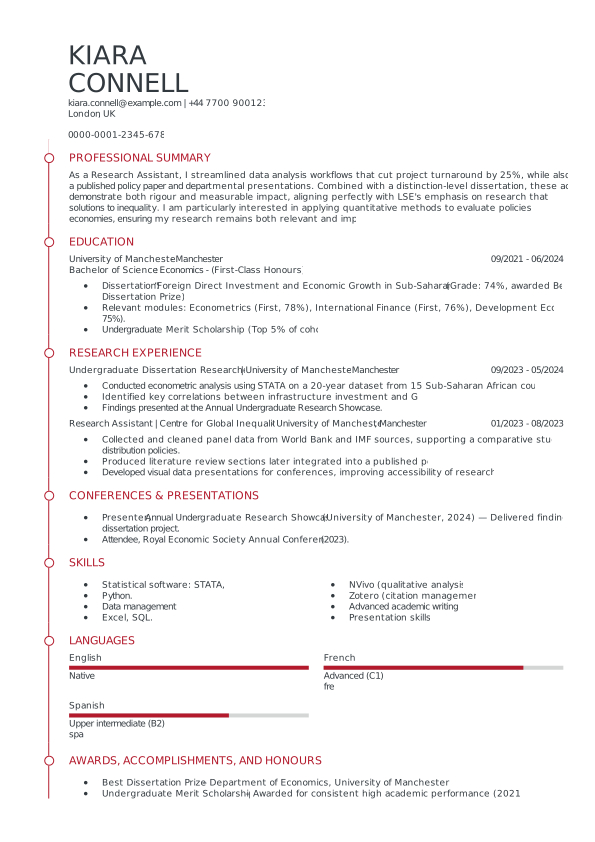
Getting ready to apply to the London School of Economics? Explore our expertly designed LSE CV examples, tailored for postgraduate and research applications. These samples show you exactly how to highlight your education, research, and achievements in a format that meets LSE’s expectations. Use them as inspiration to build a polished application that strengthens your profile and helps you stand out in a competitive admissions process.

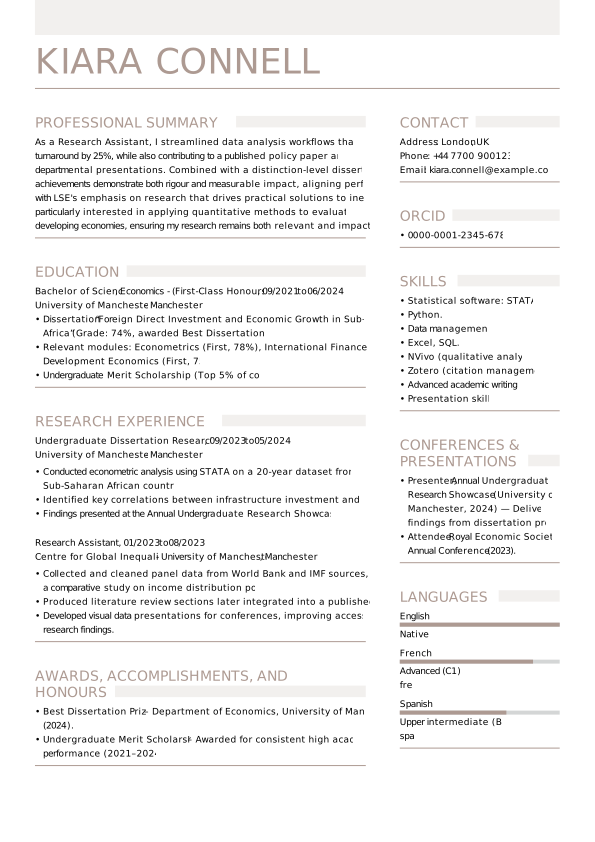
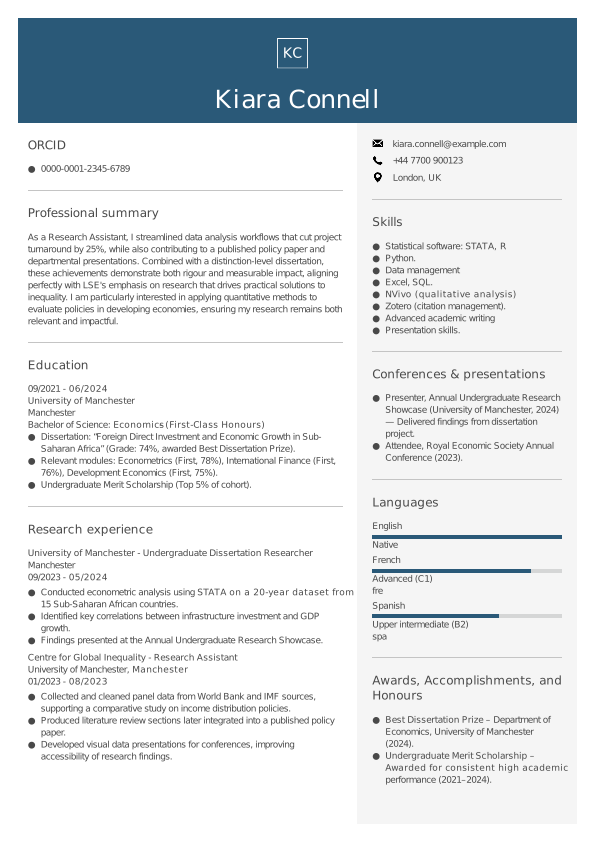
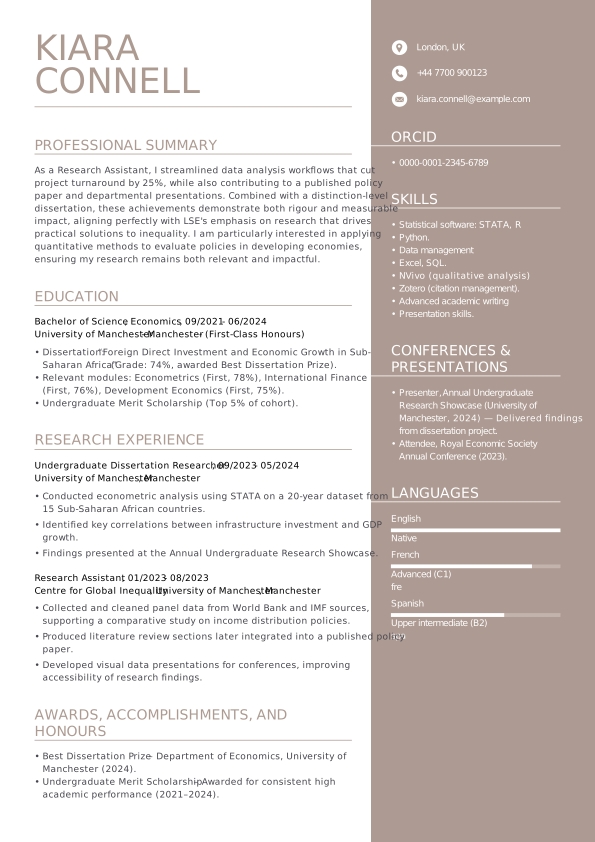
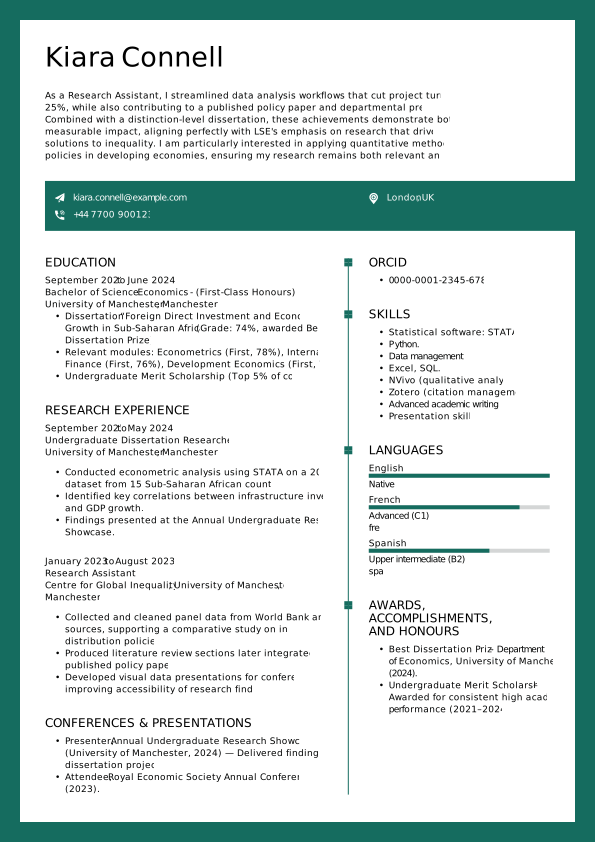
Research assistant LSE CV example

This Research Assistant LSE CV example is designed for applicants targeting postgraduate and research programmes at the London School of Economics. It highlights academic achievements, research projects, and publications in a structured, evidence-based format that reflects LSE’s expectations. With clear sections for education, research experience, and awards, this template helps you present your academic trajectory with professionalism and precision, making it an excellent fit for competitive applications to LSE.

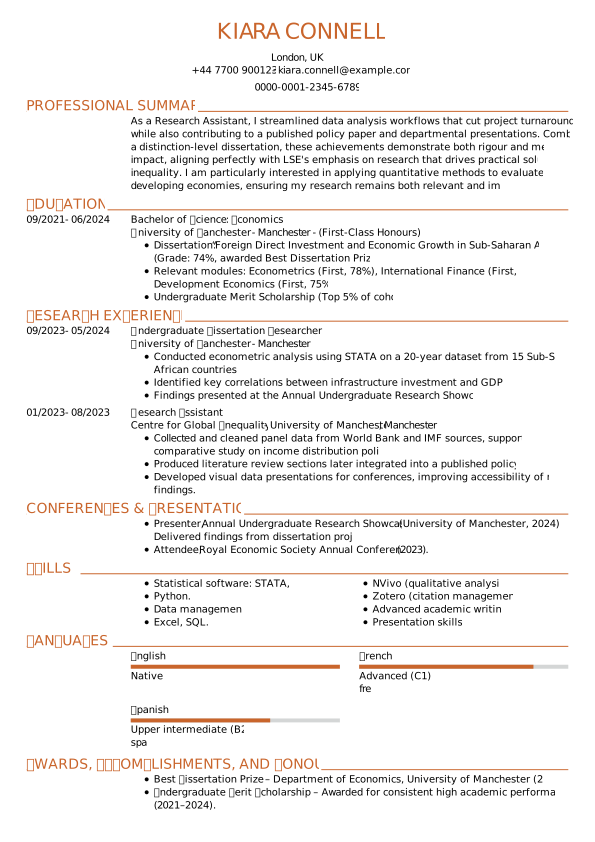
PhD programme LSE CV example
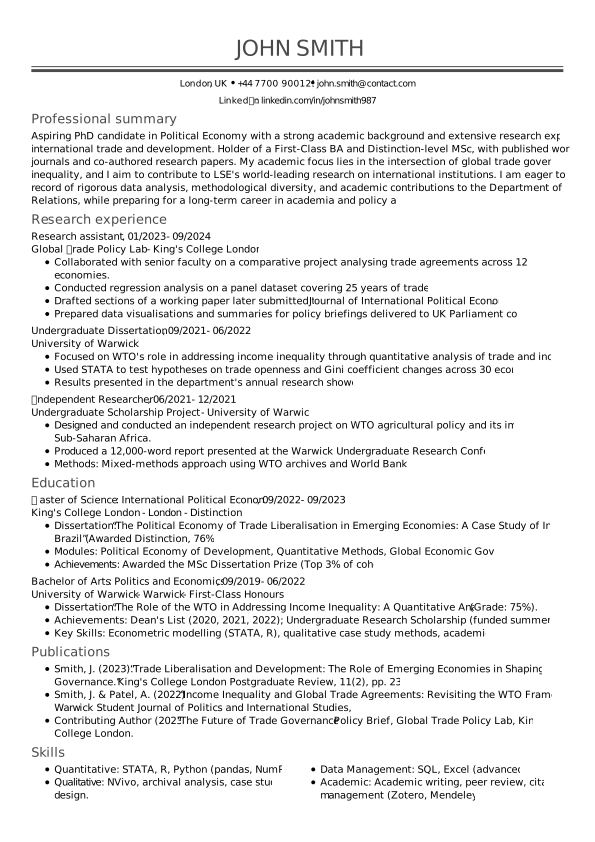
This PhD CV template is tailored for postgraduate research applicants at LSE. It highlights key academic achievements, including distinctions at undergraduate and master’s level, detailed research experience, and peer-reviewed publications. With dedicated sections for education, research projects, and scholarly contributions, this CV demonstrates strong preparation for doctoral study.

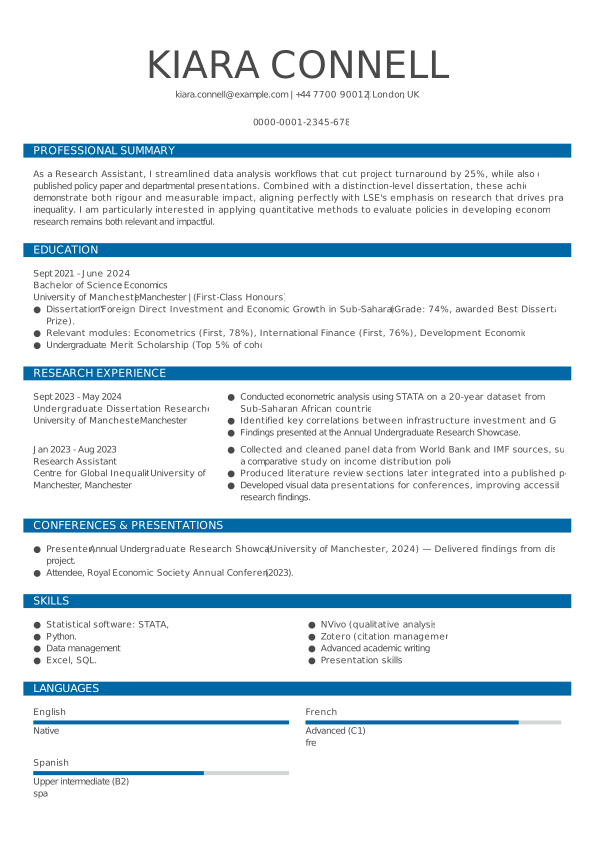
Scholarship application LSE CV example
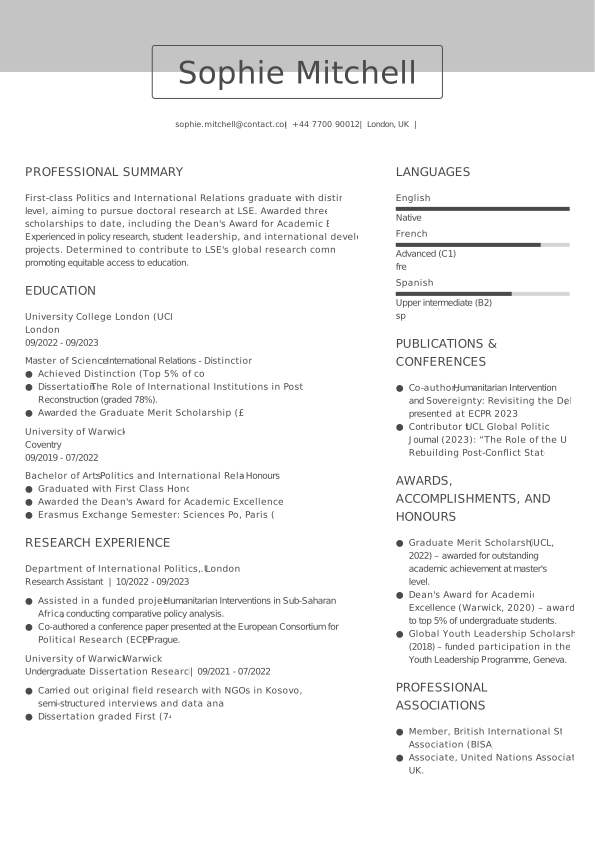
This LSE CV example strikes a balance between academic merit and extracurricular leadership, which is essential when applying for scholarships. It showcases awards, funding, and contributions beyond the classroom while keeping a professional academic focus.

How to format an LSE CV

Most of the CV formatting rules that are true for a job CV are also correct for an LSE CV, but there are a few differences. Here are the rules you should follow when writing your CV for LSE applications:

  • An LSE CV, like any other academic CV, has no strict length limit and is typically 3-5 pages long, but it can be longer, especially for PhD programmes.
  • Use a good font for your CV, such as Arial, Calibri, or Times New Roman. Avoid decorative or stylised fonts.
  • Use 10–12 pt font size for body text and 14–16 pt for section headers.
  • Keep margins between 1.5–2.5 cm for readability.
  • Set single spacing within entries, with a blank line between sections. Avoid large blocks of text. Break information into bullet points for clarity.
  • Write clear section headings (e.g., Education, Research Experience, Publications, Languages).
  • Choose the reverse-chronological formatting style. It shows your most recent qualifications first.

Tips for tailoring your CV for LSE postgraduate applications

Submitting a generic CV won’t be enough for a competitive school like LSE. Every line should reflect why you are a strong fit for the programme you’re applying to. Here are key tips to help you tailor your CV:

  • Mirror the programme description: Read the course page carefully and note specific modules, methods, or themes. For example, if the MSc in International Relations highlights policy analysis, make sure your CV showcases any research or coursework in that area.
  • Highlight academic achievements first: Unlike job-focused CVs, academic applications value grades, dissertations, and research. Place education and research sections prominently near the top.
  • Show research potential: For MSc or PhD applications, admissions tutors want to see that you can handle independent inquiry. Use bullet points under dissertations, projects, or assistant roles to detail your methods, findings, and impact.
  • Connect professional experience to academia: If you’ve worked in industry, highlight the transferable skills that align with your chosen programme.
  • Include relevant extracurriculars: If you’ve been part of academic societies, debate clubs, or attended specialist summer schools, include them. These activities show intellectual curiosity and a strong interest in your field.
  • Tailor your personal profile statement: Make clear why LSE. Mention specific professors, research centres, or modules that align with your goals. Avoid generic statements like “I want to pursue further study.”
  • Keep it evidence-based: Back up every claim with specifics: a grade, a prize, a presentation, or a measurable outcome. LSE selectors prefer hard evidence over broad claims of skill.
  • Adapt for taught vs. research programmes: For MSc/LLM, focus on academic ability and transferable work skills. For a PhD, emphasise prior research experience, methods mastered, and readiness to produce original contributions.

Common mistakes to avoid in an LSE CV

When applying to one of the most competitive universities in the world, even small errors in your CV can weaken your application. Avoid these common pitfalls to make sure your CV meets LSE’s high standards:

  • Submitting a generic CV: Sending the same CV to every university shows a lack of preparation. LSE expects a CV tailored to their programme, not a one-size-fits-all document.
  • Overloading with work history: Unlike job applications, postgraduate and research CVs should prioritise education and research achievements. Don’t waste space on unrelated part-time jobs unless you can link them to relevant skills.
  • Too much jargon: Overly technical language can make your CV hard to follow. Remember, admissions staff may not all be specialists in your narrow field. Keep explanations clear and concise.
  • Vague or unquantified achievements: Phrases like “helped with research” or “participated in projects” don’t impress selectors. Always be specific: What methods did you use? What was the outcome? Did you earn a grade, prize, or publication?
  • Ignoring formatting rules: Poor spacing, inconsistent fonts, or cluttered layouts can make your CV hard to read. LSE receives thousands of applications — make sure your CV looks professional and polished.
  • Weak personal profile: A vague or generic opening statement like “I am passionate about economics” won’t stand out. Instead, use this section to link your academic background and career ambitions directly to LSE’s programme.
  • Omitting bonus sections: Leaving out publications, conferences, languages, or awards misses opportunities to show depth. These sections can give you a crucial competitive edge.

Key takeaways

  • Know the rules: CVs are not required for undergraduate LSE applications, but they are mandatory for postgraduate and research programmes.
  • Focus on academics first: Place your education, research experience, and academic achievements at the heart of your CV.
  • Tailor to LSE: Align your CV with the programme description, highlighting relevant modules, skills, and methods that match what LSE is looking for.
  • Show evidence, not claims: Use quantified results (grades, awards, publications) instead of vague statements about skills or interests.
  • Polish your presentation: Keep your CV clear and don’t worry about length. As LSE states on their PhD resources page, “Length is unimportant – can run to several pages.

Secure your place at LSE with a tailored LSE CV template

Applying to LSE? Our CV templates provide a strong academic foundation, helping you showcase qualifications, research experience, awards and more. Each template is easy to customise, includes pre-written guidance, and is available to download instantly in several file types. MyPerfectCV gives you everything you need for a polished LSE-ready CV.
Build Cv Image

*The names and logos of the companies referred to above are all trademarks of their respective holders. Unless specifically stated otherwise, such references are not intended to imply any affiliation or association with myperfectCV.

Need help?