Job-Winning Banker CV Examples (2026)
Demonstrate financial precision and land your next role. Create a professional banker CV that highlights your expertise and secures more interviews today.

- Our customers have been hired by : *Foot Note
Banking roles demand precision, trust, and a strong understanding of financial processes. Whether applying for retail, commercial, or investment banking roles, a well-written CV is essential for standing out in a competitive hiring environment.
A strong banker CV should clearly demonstrate:
- Financial knowledge and awareness of banking regulations
- Experience managing client relationships and sensitive information
- Measurable achievements, such as process improvements or customer outcomes
- A clear, professional structure that highlights skills, experience, and qualifications
On this page, you’ll find:
- Good CV examples for banking that show what employers look for
- Banker CV templates you can customise for different bank roles
- Step-by-step guidance on writing a professional banking CV
- FAQs answering common questions about CVs for bank jobs
Smarter writing with built-in AI
Get instant, high-quality text suggestions tailored to your specific industry.
SEARCH ALL CV EXAMPLES
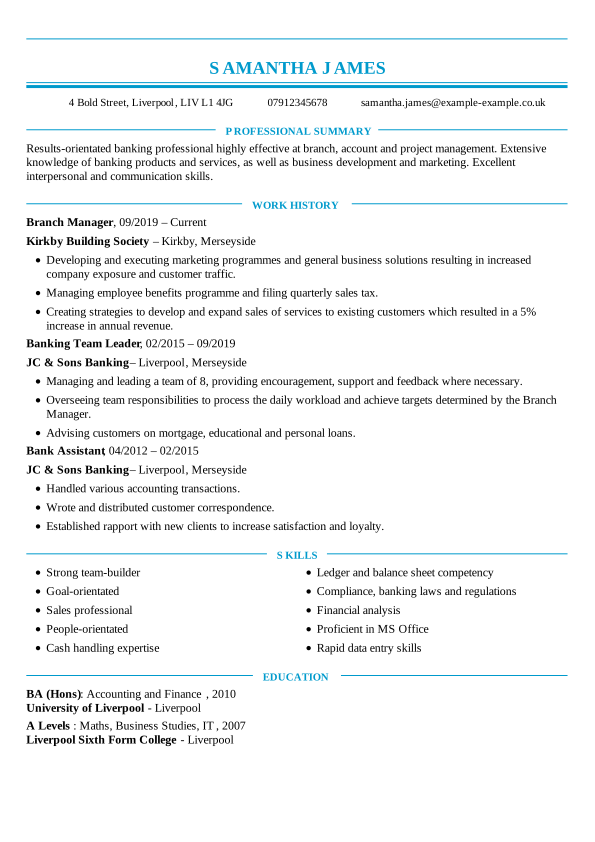
CV for a bank job (example)
Samantha James
4 Bold Street
Liverpool, LIV LI 1JG
07912 345 678
samantha.james@example-example.co.uk
Professional summary
Results-orientated banking professional highly effective at branch, account and project management. Extensive knowledge of banking products and services, as well as business development and marketing. Excellent interpersonal and communication skills.
Work history
Branch Manager (09/2019 – Current)
Kirkby Building Society – Kirkby, Merseyside
- Developing and executing marketing programmes and general business solutions resulting in increased company exposure and customer traffic.
- Managing employee benefits programme and filing quarterly sales tax.
- Creating strategies to develop and expand sales of services to existing customers which resulted in a 5% increase in annual revenue.
Banking Team Leader (02/2015 – 09/2019)
JC & Sons Banking – Liverpool, Merseyside
- Managing and leading a team of 8, providing encouragement, support and feedback where necessary.
- Overseeing team responsibilities to process the daily workload and achieve targets determined by the Branch Manager.
- Advising customers on mortgage, educational and personal loans.
Bank Assistant (04/2012 – 02/2015)
JC & Sons Banking – Liverpool, Merseyside
- Handled various accounting transactions.
- Wrote and distributed customer correspondence.
- Established rapport with new clients to increase satisfaction and loyalty.
Skills
- Strong team-builder
- Goal-oriented
- Sales professional
- People-orientated
- Cash handling expertise
- Ledger and balance sheet competency
- Compliance, banking laws and regulations
- Financial analysis
- Proficient in MS Office
- Rapid data entry skills
Education
BA (Hons): Accounting and Finance (2010)
University of Liverpool – Liverpool
A Levels: Maths, Business Studies, IT (2007)
Liverpool Sixth Form College – Liverpool
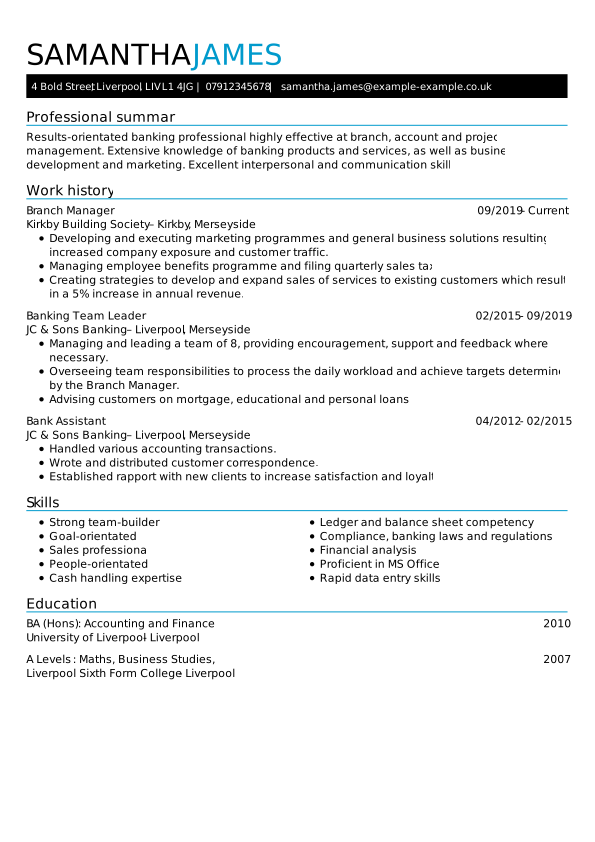
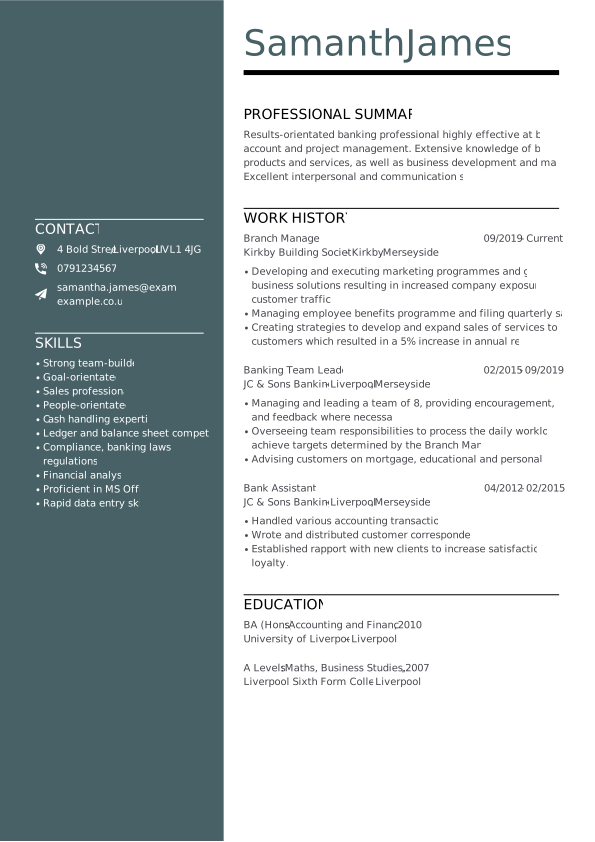
Banker CV templates
Using a professional CV template helps ensure your banker CV is clear, well-structured, and aligned with banking recruitment standards. Our ready-to-use templates are designed to present financial experience, achievements, and qualifications in a clean, professional format.
Each template can be customised using our CV builder, making it easier to organise key information and create a strong banking CV without spending hours on formatting.
Best banking CV format
Choosing the right CV format is essential when applying for banking roles. Recruiters need to quickly understand financial experience, responsibilities, and how skills have developed over time. A clear, well-organised CV makes it easier to assess suitability, particularly in a competitive and highly regulated sector.
The two most effective formats for a banker’s CV are the reverse-chronological CV and the skills-based CV.
Reverse-chronological banking CV format
The reverse-chronological CV lists roles starting with the most recent and works backwards. This is the format most banking recruiters expect and is widely used across retail, commercial, and investment banking roles.
This format is ideal if you want to:
- Show steady career progression within banking or finance
- Highlight recent roles, responsibilities, and achievements
- Demonstrate experience handling clients, accounts, or financial processes
It works particularly well for candidates with at least one year of relevant banking experience, including graduate schemes or analyst roles.
Skills-based banking CV format
A skills-based CV focuses on capabilities rather than job titles. Instead of leading with work history, it groups key skills under clear headings, allowing employers to assess potential quickly.
This format is useful if you want to:
- Highlight transferable skills such as financial analysis, risk awareness, or client communication
- Include experience from education, internships, or part-time roles
- Apply for entry-level bank jobs or graduate positions
It’s commonly used by recent graduates, career changers, or candidates with limited direct banking experience.
Banker CV formatting tips
- Keep the CV 2 pages long: Focus on relevant banking experience and achievements
- Use clear section headings: Profile, skills, experience, and education should be easy to scan
- Choose good-looking CV fonts: Serif fonts like Times New Roman or Garamond work best.
- Maintain a professional layout: Simple, consistent formatting reflects attention to detail
- Don’t include a photo: Photos aren’t typically required for UK job applications.
How to write a banker CV step-by-step
Knowing how to write a strong CV for banking is an essential skill that you’re likely to use many times throughout your banking career. Once you’ve chosen the right CV format, it’s time to focus on the content that will hopefully grab a recruiter’s attention. Thanks to our expert tips, you’ll be able to create a well-organised banking CV that not only demonstrates your qualifications but also positions you as a strong candidate for the role.
Here’s what this guide will cover:
- Step 1: Add your contact details
- Step 2: Start your banker CV with a personal statement
- Step 3: Outline banking experience in your banker CV
- Step 4: Include banking skills recruiters look for
- Step 5: Include your education and qualifications
Step 1: Add your contact details
The contact section is the first part of your banking CV, ensuring potential employers can easily identify and reach out to you for the role. Make sure all the details are up to date and easy to read. It should include:
- Full name: Your first and last names are clearly stated.
- Location: The city or country where you’re based, and note if you’re open to relocation.
- Phone number: A reliable number where you can be reached.
- Email address: A professional, work-appropriate email address that you check regularly.
Example contact section
Samantha James
Liverpool
07912 345 678
samantha.james@example.co.uk
Step 2: Start your banker CV with a personal statement
Your personal statement sits at the top of your CV and gives recruiters a quick summary of why you’re a strong fit for a banking role. Whether applying for a position in retail banking, commercial banking, or investment banking, this section should highlight relevant experience, key achievements, and areas of expertise.
Keep your personal statement to three or four concise sentences. The aim is to capture attention quickly and encourage recruiters to continue reading.
Tips for writing an effective banker CV personal statement:
- Write it last: Once the rest of your CV is complete, it’s easier to identify the most important points to highlight.
- Focus on measurable achievements: Where possible, include results that demonstrate impact, such as improving processes, supporting clients, or meeting performance targets.
- Use banking-specific keywords: Reflect terminology from the job description, such as compliance, financial analysis, risk management, lending, or customer relationship management.
A clear, targeted personal statement helps set the tone for your CV and positions you as a credible candidate from the outset.
Example of a personal statement for a banker CV
“Detail-oriented banking professional with experience supporting day-to-day financial operations and client services. Skilled in handling transactions accurately, maintaining compliance standards, and building trusted client relationships. Seeking a banking role where attention to detail, reliability, and financial awareness are valued.”
Step 3: Outline banking experience in your banker CV
The work experience section is one of the most important components of a banking CV. Employers in the banking sector prefer candidates with proven experience that’s also relevant to the requirements and duties of the role, as this demonstrates the candidate’s ability to adapt quickly and require less training. For a strong CV, list your current and previous roles in reverse chronological order, focusing on your key responsibilities and achievements in each position.
If a position is outdated or no longer reflects your current skills, consider leaving it out. Additionally, omit roles that don’t emphasise transferable banking skills.
To format this section, include the following details:
- Job title
- Company name and location
- Start and end dates of employment
- Key responsibilities.
Example work experience section
Senior Relationship Manager
CityBank Financial Solutions, London
January 2021 – Present
- Managed a portfolio of 150 high net worth clients, delivering personalised financial solutions and increasing client retention by 20% year on year.
- Conducted in-depth financial analysis to assess client needs, resulting in the successful structuring of £15M in investment portfolios.
- Ensured full compliance with financial regulations and anti-money laundering policies, achieving a 100% audit pass rate.
- Led cross-departmental teams to implement new banking products, increasing revenue by 16% in the first quarter after launch.
Banking Operations Officer
Global Financial Partners, Manchester
March 2018 – December 2020
- Oversaw daily banking operations, including processing over 180 transactions per day, ensuring 99.7% accuracy in all financial transactions.
- Provided risk assessments and recommendations on loan applications, approving over £10M in personal and commercial loans while maintaining a low default rate.
- Trained and mentored a team of five junior staff members, improving team productivity by 35% through targeted training initiatives.
- Facilitated the implementation of new digital banking systems, improving transaction efficiency by 20%.
Step 4: Include banking skills recruiters look for
Banking is a competitive field, so when writing your CV, you need to focus on your technical and transferable skills. A strong understanding of financial regulations and compliance is essential, as is the ability to navigate financial software and tools. Employers also seek excellent communication and negotiation skills to interact effectively with clients. Finally, soft skills like problem-solving and attention to detail are crucial for managing complex client requests and ensuring smooth banking operations.
Requirements to become a banker also include an understanding of financial and banking codes, customer service, and stock market knowledge. Additional skills can vary depending on the type of banker you want to be. For example, business banker skills will differ from those of a private banker CV, with a stronger focus on understanding how businesses operate and manage cash.
Essential skills for a banker
- In-depth knowledge of UK banking codes and regulations
- Strong proficiency in mathematics and financial analysis
- Expertise in cash management and transaction processing
- Customer service skills with a focus on relationship building
- Proven ability to manage and lead teams effectively
Added extras for your banker CV
- Strong problem-solving and analytical skills
- Discipline and patience in high-pressure situations
- Effective communication skills, both written and verbal
- Exceptional time management and organisational abilities
- Keen attention to detail, ensuring accuracy in all tasks
Step 5: Include your education and qualifications
While experience is important, relevant qualifications can strengthen your application — particularly for graduate, analyst, or specialist banking positions.
Include degrees in areas such as finance, business, economics, or accounting, as these align closely with banking roles. Professional certifications, such as Chartered Financial Analyst (CFA) or Financial Risk Manager (FRM), can also add credibility and help distinguish your CV from other candidates.
When listing education on a CV, prioritise qualifications that are relevant to banking and financial services. You may also highlight modules or coursework related to areas such as financial regulation, investment analysis, risk management, or corporate finance.
What to include in your education section:
- Name of the institution and completion date
- Qualification level (degree, diploma, A-levels, or equivalent)
- Relevant subjects or specialisms
- Grades or results (optional, but useful if strong)
Example education section
London Business School — Master of Finance (MSc)
September 2019 – November 2020
- Focused on advanced financial management, risk assessment, and portfolio management
- Completed a dissertation on “The Impact of Financial Technology on Traditional Banking Models”
- Graduated with Distinction, demonstrating expertise in financial analysis and investment strategies
University of Cambridge — Bachelor of Science in Economics
September 2016 – June 2019
- Relevant coursework: Financial Analysis, Investment Strategies, Corporate Finance, Banking Regulations
- Achieved a 2:1 degree, with a strong emphasis on financial modelling and economic theory
- Actively participated in the Economics Society, organising guest lectures and discussions on global financial markets
Step 6: Add bonus sections to strengthen your banker CV
Once you’ve covered the essentials, adding a few well-chosen extra sections can give your banker CV a competitive edge. These sections help you showcase depth, professionalism, and commitment to your career.
Banking CVs often include extra sections like certifications, awards, or professional activities to demonstrate expertise beyond core experience. Bonus sections can include:
- Certifications and licences: Highlight credentials such as CFA, CeMAP, or AML certifications. These show your technical knowledge and commitment to professional development.
- Professional memberships: Include affiliations with organisations like the Chartered Banker Institute or other finance-related bodies.
- Languages: Fluency in additional languages is a strong advantage in banking, especially for client-facing or international roles.
- Awards and achievements: Showcase recognitions such as “Top Performer”, “Employee of the Month”, or academic distinctions.
- Projects or initiatives: Mention relevant projects, such as improving internal processes, supporting digital transformation, or participating in financial campaigns.
If you’re a junior candidate, bonus sections can help compensate for limited work experience. For more experienced bankers, they’re a great way to highlight specialisation and career progression.
Do’s and don’ts for a banker CV
Use industry-accurate language that matches the role. For example:
- Retail banking: account management, lending, customer due diligence
- Commercial banking: credit analysis, cashflow assessment, relationship management
- Investment banking: financial modelling, valuation, deal support
Generic finance language weakens credibility.
Banking CVs are judged heavily on recency. Focus detail on roles from the last 10–15 years, especially those involving regulated responsibilities, client exposure, or financial decision-making.
A banking CV should be more controlled and risk-aware than a general finance CV. Avoid overemphasising creativity, innovation, or “fast-paced environments” unless directly relevant to the role.
Retail, hospitality, or admin roles from early career stages should be condensed or removed unless they demonstrate skills directly relevant to banking, such as cash handling, compliance, or client trust.
Your banker CV questions answered
What is a recommended banker CV layout?
A clear, well-organised layout helps your CV stand out. Here’s a simple structure to follow:
Contact details – Name, phone number, email, LinkedIn (optional)
Personal statement – 3–4 lines highlighting your experience and goals
Key skills – Bullet points listing relevant skills (e.g. financial analysis, customer service)
Work experience – List jobs in reverse order, with role, company, dates, and key achievements
Education – Degree, institution, graduation date
Certifications – Any relevant qualifications (e.g. CeMAP, CFA)
Optional extras – Languages, software skills, or volunteering
How do I write a CV for a bank job that stands out?
An effective banker CV will be tailored to a specific banking role and its requirements and will not include any irrelevant skills, accomplishments or job responsibilities. It will highlight critical skills like ‘ledger and balance sheet competency’ and ‘cash-handling expertise’ in well-defined sections. The CV will also be cleanly formatted with short paragraphs, direct sentences and bullet points.
Is it important to list specific banking software on my CV?
Yes, listing banking software on your CV is a great idea. It shows that you have the specialised knowledge and experience to use word processing, code banking, or financial reporting systems. Mentioning these tools shows that you’re familiar with the digital tools that streamline banking processes. Be sure to also explain how your software experience contributes to your overall skills, such as improving efficiency or customer satisfaction.
Should I include a section for references on my banker CV?
Including a reference section in your banking CV is generally not mandatory unless the employer specifically requests it. You can add a simple line at the end of your CV, such as “References available on request”, to let recruiters know that you’re willing to provide them if required.
What skills do you need as an investment banker?
As an investment banker, you’d be helping companies to reach their financial goals and develop financial plans. Key investment banker duties include raising client capital, networking, analysing financial data, and presenting information to clients. Due to these complex duties, the skills needed to become an investment banker include an in-depth understanding of financial modelling, along with strong communication skills.
What are the duties of a banker?
The duties you choose to list will depend on both your experience and the role you want to secure. Some examples of highly valued banking responsibilities to mention are:
- Client relationship management (e.g. “built and maintained relationships with over 100 high net worth clients”)
- Risk management and compliance (e.g. “ensured 100% compliance with banking regulations, minimising risk exposure”)
- Financial analysis and reporting (e.g. “performed detailed financial analysis resulting in a 15% increase in portfolio performance”)
- Sales and business development (e.g. “generated £1m in new business by securing five new client accounts”)
What qualities make a good banker?
To fulfil their banker job duties successfully, a candidate will need an understanding of banking, finance, and mathematics, along with customer service and team management skills. Additional skills, including speaking another language, are always a plus.
Related Finance CV Examples

Create your banker CV today
Create a professional banking CV using our banker CV examples, templates, and easy-to-use CV builder. With clear guidance and role-specific layouts, you can present experience, achievements, and qualifications in a format that meets banking recruitment standards and helps secure interviews.