
Farm worker CV examples, template & writing guide
Keep fields thriving and advance your career. Build a professional farm worker CV that highlights your practical skills and lands your next role today.

- Our customers have been hired by : *Foot Note
Agriculture runs on strong foundations, and your farm worker CV is no different. Employers use it to judge your work ethic, hands-on abilities, and potential to support daily farm operations. In this guide, you’ll learn how to write a farmer CV that’s tailored to secure your next role in agriculture.
Draw inspiration from CV examples. You’ll find plenty of expert guidance covering everything from personal statements to employment background.
Smarter writing with built-in AI
Get instant, high-quality text suggestions tailored to your specific industry.
SEARCH ALL CV EXAMPLES
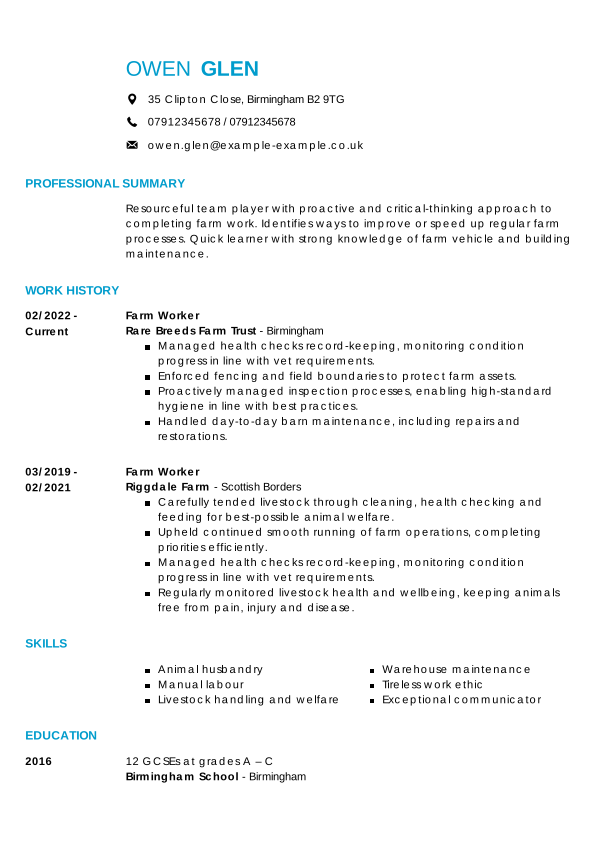
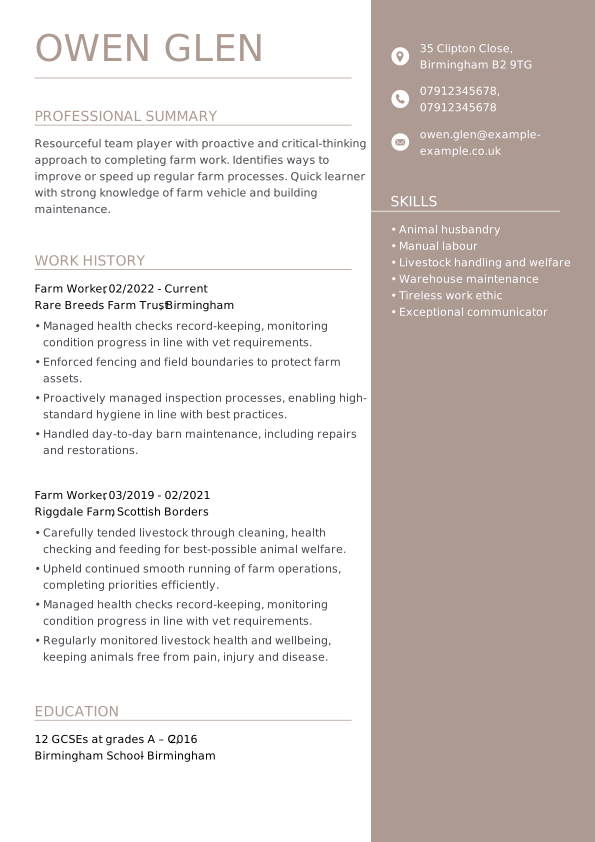
Farm worker CV example

Owen Glen
Farm worker
35 Clipton Close
Birmingham B2 9TG
07912345678
owen.glen@example-example.co.uk
Professional summary
Reliable farm worker with over 6 years of hands-on experience supporting daily livestock, land, and machinery operations. Proven ability to streamline routine processes, maintain high welfare standards, and carry out essential maintenance to keep farms running safely and efficiently. Recognised for a strong work ethic, fast learning, and a proactive approach to identifying improvements across animal care, hygiene, and equipment upkeep. Eager to help Greenfield Heritage Farm boost productivity, strengthen animal welfare standards, and maintain a well-run, sustainable farming environment.
Work history
Farm Worker
February 2022–Present
Rare Breeds Farm Trust, Birmingham
- Maintains detailed and accurate livestock health records, supporting vets and improving early detection of condition changes.
- Strengthens fencing and field boundaries to protect livestock and farm assets, reducing escape incidents.
- Leads daily and weekly inspection routines to ensure excellent hygiene standards and compliance with best-practice welfare guidelines.
- Handles ongoing barn maintenance, completing minor repairs and restoration tasks to maintain a safe working environment.
- Supports seasonal farm activities, including feed management and routine animal handling.
Farm Worker
March 2019–February 2021
Riggdale Farm, Kelso
- Provided daily care for livestock, including feeding, health checks, and welfare monitoring to maintain injury- and disease-free herds.
- Helped maintain smooth farm operations by completing varied labour tasks efficiently and to a high standard.
- Recorded health and treatment information to assist in long-term herd management.
- Monitored livestock behaviour and wellbeing, reporting concerns promptly to farm supervisors.
Education
2016
Birmingham School, Birmingham
12 GCSEs at grades A–C
Skills
- Animal husbandry
- Manual labour
- Livestock handling and welfare
- Warehouse maintenance
- Tireless work ethic
- Exceptional communicator
Certifications & Licences
- Level 2 Award in Safe Use of Pesticides (PA1), 2022
- Tractor Driving & Machinery Operation Certificate, 2021
- Emergency First Aid at Work, 2020
- Animal Transport Certificate, 2019
Farmer CV template
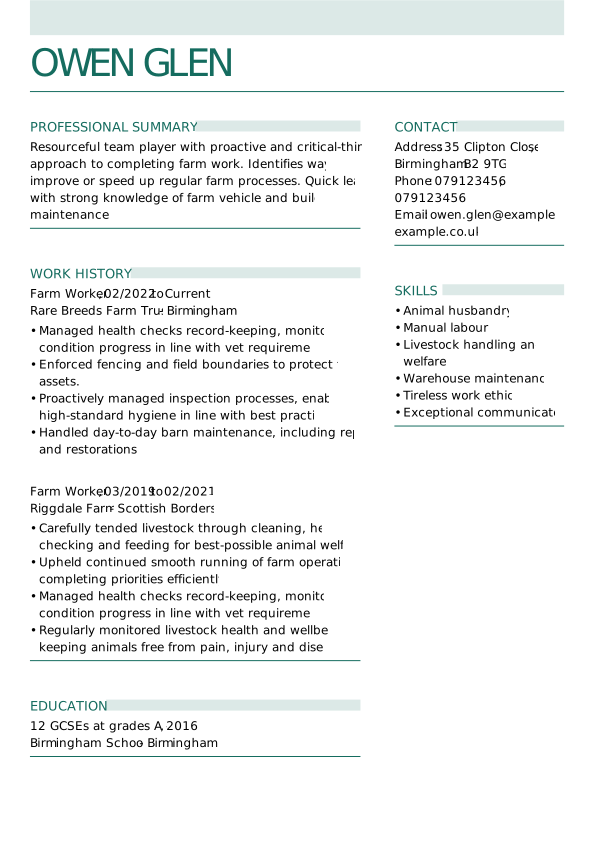
Writing a farm worker CV doesn’t have to be complicated. Alongside the following tips and examples, we also have pre-made farm worker CV templates to showcase your experience, skills, and qualifications in the best possible light.
Choosing the right format for your farm worker CV
Before putting pen to paper, you must choose between popular CV formats. There are two main CV formats in the UK that come out on top: the reverse-chronological CV and the skills-based CV.
- Reverse-chronological CV runs through your work history, starting from your current or most recent role. You can discuss part-time positions, apprenticeships, and temporary contracts alongside full-time jobs.
- Skills-based CV prioritises transferable skills, such as communication, problem-solving, and teamwork.
We suggest using the reverse-chronological format, as employers usually prefer candidates with practical experience. However, if you’re joining an agricultural field, you’ll find plenty of casual and seasonal farm worker positions that only require a positive attitude and willingness to learn. In these cases, there’s nothing wrong with sending a skills-based CV.
Alongside choosing the correct layout, here are some other tips:
- Your CV should be one to two pages long, maximum
- Create multiple CVs for specific jobs
- Type in a professional CV font like Times New Roman or Arial
- Avoid tables, images, or anything else that clutters the page
- Send your CV as a PDF document unless asked otherwise
How to write an agriculture CV for a farm worker
If you’re wondering how to write a CV that stands out from the crowd, you’re in luck. The following sections explain the ins and outs of CV writing, paired with answers to some of the most common farm worker CV questions.
- Add contact details to your farm worker CV
- Start your farm worker CV with a personal statement
- Present your work history on a farm worker CV
- Highlight your strengths in the CV farmer skills section
- Include education in your farm worker CV
- Boost your farm hand CV with extra sections
- Attach a farm worker cover letter
Add contact details to your farm worker CV
Start with your most up-to-date contact details. Put them at the top of the page, preferably in a slightly larger or bolder font. Key information includes:
- Name – first name and surname
- Location – including postcode
- Phone number – the best one to reach you on
- Email address – keep it work appropriate
Jack McDonald
The Barns
Ruralhope
Hertfordshire, CL29 HSN
01234 55553444
jackmcdonald@example.com
Start your farm worker CV with a personal statement
The secret to making a good first impression is to write a personal statement that shows your experience and key strengths. There’s a catch: you only have 3–4 sentences to spark the reader’s interest.
Luckily, we have an expert formula that gets straight to the point:
- Sentence 1: Introduce who you are, including your years of experience and career focus.
- Sentence 2: Show what you can achieve with a strong, factual example or statistic (e.g., “revolutionised arable farming processes, boosting efficiency by 79%” or “managed a dairy of 250 cows”). The more specific you are, the more credible you’ll sound.
- Sentences 3–4: Highlight your most valuable skills and key specialisms.
Don’t exceed four sentences, which works out somewhere between 50 and 100 words. Here are some other tips to inform the writing process:
- Write in the third person to give your CV a polished edge
- Use positive adjectives like “friendly”, “organised”, and “strong”
- Keep the tone professional – avoid jokes, idioms, and informalities
- Tailor all the information to the job advertisement
- Be authentic – think about what makes you truly unique
Experienced and well-qualified stockman with over 5 years of hands-on experience working with hill beef cattle across Scotland and northern England. Skilled in handling Belted Galloway, Highland, English Longhorn, Charolais, and other traditional breeds, with current expertise in managing rare-breed cattle. Proficient in calving both indoors and on the hill, supported by broader mixed-farm experience in milk parlour work, lambing, and haylage/silage production. Brings a reliable, safety-focused approach and a proven ability to support smooth, efficient livestock operations.
OR
Motivated and physically capable farm worker with over 3 years of experience across livestock and arable farming environments. Confident in tractor and trailer operations and highly computer-literate, supporting accurate farm administration and record-keeping. Known for a positive work ethic, enthusiasm, and long-term commitment to the farming profession. Now seeking a position on a larger estate or trust where I can contribute effectively to daily operations while developing more advanced machinery and farm management skills.
Present your work history on a farm worker CV
Hiring managers will love the work history section of your farm CV if it shows your work ethic and attitude toward farm hand duties. Start it with your current or most recent role and list 3–6 responsibilities under each, noting more for relevant positions. You can list part-time, seasonal, or temporary contracts alongside full-time employment.
Each job description should cover your:
- Job title
- Employment start and end dates
- Company name
- Company location
- Short list of responsibilities
- Workplace achievements
Back up your farm duties with facts and figures. This will reassure the employer that you have what it takes to succeed. Let’s say you “organised open days for the public”; can you explain the outcome? For example, “sold 55 season tickets” or “collected £2,000 in funding”. Adding these details will set you apart from equally qualified applicants!
It’s a good idea to cover a range of responsibilities and areas of expertise. For example, if you’ve mentioned “repairing machinery” underneath one job, talk about “herding cattle” in another. Every role should offer brand-new information to reveal the scope of your capabilities.
Keep the tone lively and engaging. Use positive adjectives to describe your personality, such as “hardworking”, “disciplined”, and “organised”. Include powerful action verbs instead of “responsible for”, e.g., “yielded”, “operated”, and “generated”.
Farm Worker
Small is Beautiful Rare Breeds Farm Trust, Cumbria
January 2021–present
- Assisting in the day-to-day management and handling of small herds of rare-breed cattle (approx. 60 animals).
- Helping the stock manager with record keeping and other aspects of herd management.
- Organising open days for the public to boost visibility and profits.
- Repairing and maintaining farm machinery.
- Cutting costs by liaising with feed and equipment suppliers, negotiating savings of £1,500 per year.
Farm Worker
Riggdale Farm, Scottish Borders
June 2017–January 2021
- Assisted in managing a medium-sized mixed herd of around 180 cattle and sheep.
- Aided in calving and lambing on the hill.
- Oversaw an international AI programme from high-quality beef bloodlines.
Highlight your strengths in the CV farmer skills section
Impress the farm manager with your agriculture CV skills section. Show you have enough practical and transferable knowledge to hit the ground running. Go for 10 skills max, split equally between hard skills and soft skills.
- Hard skills are specialist and often learnt on the job or via formal education, such as “operating dairy machinery”, “milking cattle”, and “harvesting crops”.
- Soft skills are personality-based and more generic; think “dependable”, “responsible”, and “decisive”.
It doesn’t matter how experienced you are if you’re challenging to get along with. Similarly, an affable nature doesn’t compensate for a lack of technical know-how. You need both to present a well-rounded view of your capabilities. Employers always gravitate towards multi-talented candidates.
Stuck for inspiration? Read through the following lists for ideas:
Essential skills for a farm worker
- First Aid
- Flexibility and adaptability
- Driving licence
- Physical fitness
- Confident around machinery
Desirable aptitudes to set you apart
- Rare cattle management
- Computer literate
- Ability to remain calm in stressful situations
- Cattle handling
- Knowledge of arable farming
Include education in your farm worker CV
A comprehensive education section in a farmer CV gives you a competitive edge over equally experienced candidates. You can discuss school, college, and university courses, extracurricular training, and adult learning certificates.
What does it take to become a farm worker? It depends. Seasonal and temporary labourers are often less skilled, meaning you don’t necessarily need any qualifications. Nevertheless, employers prefer GCSEs in English, Maths, and IT alongside a can-do attitude. Without formal education, we suggest looking into farming apprenticeships.
If you’re applying for a full-time position, you could take a course at an agricultural college. These programmes cover theoretical and practical skills in crop production, animal husbandry, and farm machinery. Popular options include a “Level 1 Certificate in Practical Farm Animal Care Skill”, “T Level in Agriculture, Land Management, and Production”, and “Level 3 Diploma in Agriculture”.
When outlining your education, cover the following:
- Name of school, college, university, or other awarding body
- Study start and end dates
- Subject title
- Qualification level, e.g., T-level or Level 1 Certificate
- Qualification result
Dairy Farm, Kyedale, Scottish Borders | October 2019
First Aid Course
Rural Skills College, Kyedale, Scottish Borders | September 2017–September 2019
Rare Cattle Management Basics
Cattle Handling Basic Skills Rural Skills
Uplands School, Kyedale, Scottish Borders | August 2012–August 2017
12 GCSEs at grades A–C
Boost your farm hand CV with extra sections
Additional sections in farm worker CVs help you showcase specialist abilities and highlight valuable experience that might not fit neatly into your main sections. They’re especially beneficial if you’re applying for skilled roles, progressing in your career, or trying to stand out in a competitive field.
Here are some smart extra sections to consider:
- Certifications and licences
Show employers you’re trained, compliant, and ready to work safely from day one. Include any formal tickets such as tractor driving certificates, telehandler licences, pesticide application (PA1/PA2/PA6), animal transport certification, or First Aid. - Volunteer experience
Ideal for newcomers or seasonal workers looking to prove genuine enthusiasm for the industry. Mention hands-on activities at community farms, conservation groups, or livestock rescue centres. - Awards and achievements
A great way to show recognition for your hard work and dedication. List awards from agricultural shows, on-the-job acknowledgements, or team-based achievements such as welfare improvements or cost-saving initiatives. - Language skills
Useful on farms with seasonal or international workers, where communication helps operations run smoothly. List languages with your proficiency level (e.g. basic, conversational, fluent). - Hobbies and interests
An optional but effective way to show personality and cultural fit within a close-knit farm team. Focus on relevant interests such as animal care, countryside activities, outdoor fitness, machinery restoration, or conservation work.
Adding the right extra sections helps you present a fuller, richer picture of your abilities. It will make it easier for employers to see why you’d be a valuable addition to their team.
Attach a farm worker cover letter
Once your CV is complete, strengthen your application by attaching a tailored cover letter. This one-page document gives you the chance to introduce yourself in a more personal way, explain your interest in the role, and highlight the qualities that make you a dependable addition to the farm team.
Use your cover letter to expand on key points from your CV rather than repeating them. Not sure what to include in a cover letter? You might explain your hands-on experience with livestock, your confidence operating specific machinery, or your ability to work long hours in all weather conditions. Employers also appreciate candidates who show a genuine passion for agriculture, so don’t hesitate to mention your motivation for working on their farm.
The optimal cover letter length should be no longer than 3–4 short paragraphs. Start your cover letter by addressing the hiring manager by name if possible, refer directly to the job advert, and end with a clear call to action, such as expressing your interest in discussing the role further.
Farm worker CV dos and don’ts
A thoughtful cover letter warms the employer up before they read your application. It’s a fantastic opportunity to explain who you are and summarise your qualifications. You can also squeeze in essential details that might not fit into your CV, like why you have gaps in your employment history.
Mention your areas of expertise in your cover letter and personal statement. For example, you might specialise in a specific type of crop production or work closely with a rare breed of cattle. Highlighting your unique skills will help recruiters get your farm CV to the best people.
While it might be tempting to lift text from other people’s applications, employers can spot inauthenticity from a mile off. If you’ve never created a farm worker CV before, implement our expert tips instead of copying what you see online. On top of this, re-read the job advertisement as you work, and use the requirements to guide the writing process.
There are countless free spell-checkers online, so use them to correct any spelling or grammar mistakes. Additionally, ask a trusted loved one for feedback; another pair of eyes can catch the smallest errors.
Frequently asked questions about farm worker CVs
What are the job responsibilities of a farm worker?
Every day looks different when you work on a farm, but there’s always a long list of things to do. Daily responsibilities vary depending on the specialism, but key crossovers include:
- Feeding and looking after animals
- Ploughing fields, sowing seeds, and harvesting crops
- Ensuring farm equipment is working smoothly
- General maintenance, such as repairing fences and clearing drains
- Ordering and monitoring farm supplies
What skills does a farm worker need?
Working on a farm requires a specific set of aptitudes and practical knowledge. Luckily, you can learn most of the tools on the job, via an apprenticeship, or through a college course. Employers look for the following skills:
- Confidence in repairing and operating machinery
- Basic computer literacy
- Experience with animals, including the ability to spot illness
- Able to perform essential carpentry and maintenance tasks
- Strength, balance, and coordination
What important qualities does a farm worker need?
Farm work is mentally and physically taxing. Consequently, you must be a particular type of person to withstand the constant pressure. While rewarding, expect to be put through your paces! Qualities of a successful farm worker include:
- Able to quickly adapt to changing situations
- Meticulous attention to detail
- Problem-solving abilities
- Happy to work independently
- Regularly uses initiative
What values do farmers need?
Of course, farm workers must be caring and compassionate individuals who value animal welfare and the environment. Managing the land is a considerable responsibility, and the best farmers always try to work alongside nature rather than against it. Many fantastic initiatives now allow them to do this, including “The Sustainable Farming Scheme”.
Related Environment

Cultivate your farm worker CV with our online tools
Now that you’ve seen how simple it is to create a farm worker CV that has an immediate impact, it’s time to discover more effective ways to boost your career. We have countless clever online tools to streamline the writing process, including expert CV examples and CV templates. Explore our resources today to secure your dream job!