How to Write a Fabricator Welder CV
Highlight your technical precision and secure your next role. Build a professional fabricator welder CV with our expert tips and templates.

- Our customers have been hired by : *Foot Note
A fabricator welder’s CV should show your ability to combine technical knowledge and practical skills. You need to demonstrate your capacity to interpret designs, operate welding tools, and produce accurate, safe results. This article guides you in creating a CV that highlights your qualifications, craftsmanship, and measurable project successes.
Keep reading to find expert tips, a fabricator welder CV example, and professional templates that provide you with all the resources to make your application stand out.
Smarter writing with built-in AI
Get instant, high-quality text suggestions tailored to your specific industry.
SEARCH ALL CV EXAMPLES
Fabricator welder CV example

Siobhan Keller
Fabricator Welder
Sheffield, UK
+44 7123 456 789
siobhan.keller.welder@mail.com
linkedin.com/in/SiobhanKeller
Personal profile
Skilled fabricator welder with 10+ years of experience in industrial manufacturing and construction projects. Proven track record of delivering high-quality welds and fabrications under tight deadlines. Improved workshop productivity by 15% through a jig redesign while maintaining a 100% pass rate on weld inspections. Proficient in MIG, TIG and arc welding, blueprint interpretation, and heavy machinery operation, paired with a strong safety record (zero lost-time incidents in 5 years). Now seeking to bring my precision and efficiency to a new team, contributing to reliable, top-standard metalwork at Lylo organisation.
Work experience
Fabricator Welder
SteelCraft Engineering Ltd, Sheffield
Jan 2015–Present
- Fabricated and welded complex steel assemblies for large industrial equipment and structural frameworks, completing approximately 20 units per month with less than 1% rework needed.
- Read and interpreted detailed engineering blueprints and CAD drawings to build products to exact specifications, working closely with engineers to resolve design-for-manufacture issues.
- Introduced improved welding techniques and fixture setups that cut production time by 15% and enhanced weld consistency, earning commendation from management for process improvement.
- Maintained strict adherence to safety protocols and quality standards (ISO 9001 environment), contributing to a 5-year zero accident record and excellent audit results.
- Mentored and supervised a team of 3 junior welders and apprentices, providing training on MIG/TIG welding best practices and equipment maintenance.
Trainee Welder
Leeds Metal Works, Leeds
Feb 2014–Jan 2015
- Assisted senior welders in the fabrication of metal components, learning proper setup of welding machines (MIG and TIG) and material preparation techniques.
- Performed basic welding tasks on mild steel and aluminium under supervision, gradually achieving the skill to complete welds to quality standards independently.
- Maintained workshop tools and equipment, and kept the work area organised and safe, leading by example with correct use of PPE and adherence to safety guidelines.
- Collaborated with the team on small fabrication projects, developing a foundation in reading simple technical drawings and following project instructions precisely.
Education
Level 3 Diploma in Fabrication and Welding Engineering (City & Guilds)
City College Leeds
2011–2014
BTEC National Diploma in Mechanical Engineering
Leeds College
2009–2012
Skills
- MIG, TIG and Arc Welding Techniques: Proficient in multiple welding processes, enabling you to work with different metals, joint types and production requirements.
- Blueprint Reading & Metal Fabrication Planning: Ability to interpret technical drawings and plan fabrication steps accurately, ensuring components are built to specification.
- Operating Cutting Tools (Oxy-Fuel, Plasma) and Workshop Machinery: Competent in using cutting equipment and machinery to shape, cut and prepare metal safely and efficiently.
- Weld Inspection & Quality Control Methods: Skilled in checking weld integrity using visual inspection and measurement tools, helping maintain high production standards.
- Safety Compliance (PPE, Risk Assessments, HSE Regulations): Strong understanding of workplace safety requirements and adherence to health and safety regulations to minimise risks on the job.
- Equipment Maintenance and Troubleshooting: Capable of maintaining welding equipment and identifying issues quickly to reduce downtime and ensure consistent weld quality.
- Attention to Detail and Precision: Focused on accuracy in measurements, weld placement, and finishing to produce high-quality, reliable components.
- Teamwork and Communication on the Shop Floor: Works well with colleagues, communicates clearly with supervisors and other trades, and contributes to a smooth, coordinated workflow.
Certifications
- BS EN ISO 9606-1 Certified Welder: Qualified for MMA (Stick), MIG/MAG and TIG welding processes (obtained 2018)
- CSCS Skilled Worker Card: Construction Skills Certification Scheme, valid until Dec 2025
- First Aid at Work Certificate: St. John Ambulance, achieved 2021 (active)
Awards
- Employee of the Year (2022) – SteelCraft Engineering Ltd. Recognised for outstanding quality workmanship and productivity.
- Apprentice Welder of the Year (2014) – City College Leeds. Received for top performance in practical assessments and teamwork during the apprenticeship program.
Fabricator welder CV templates
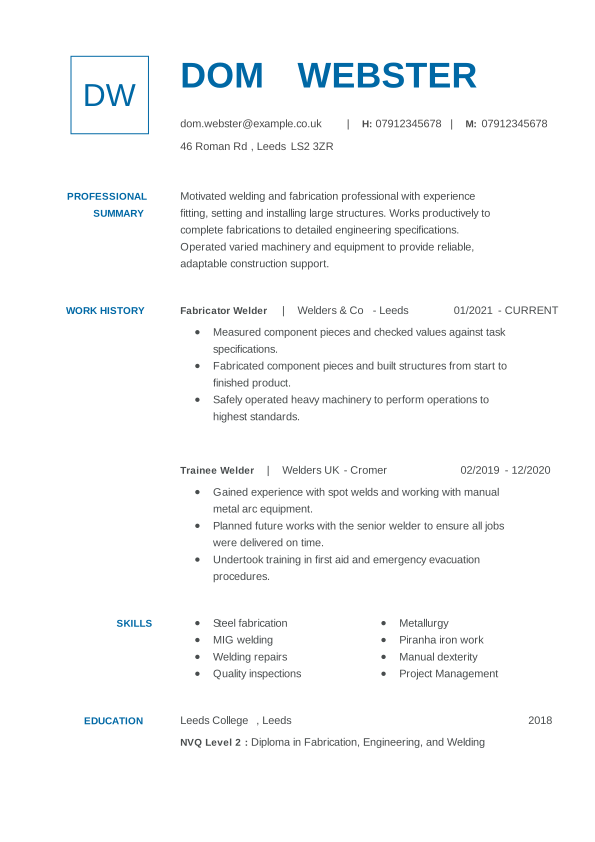
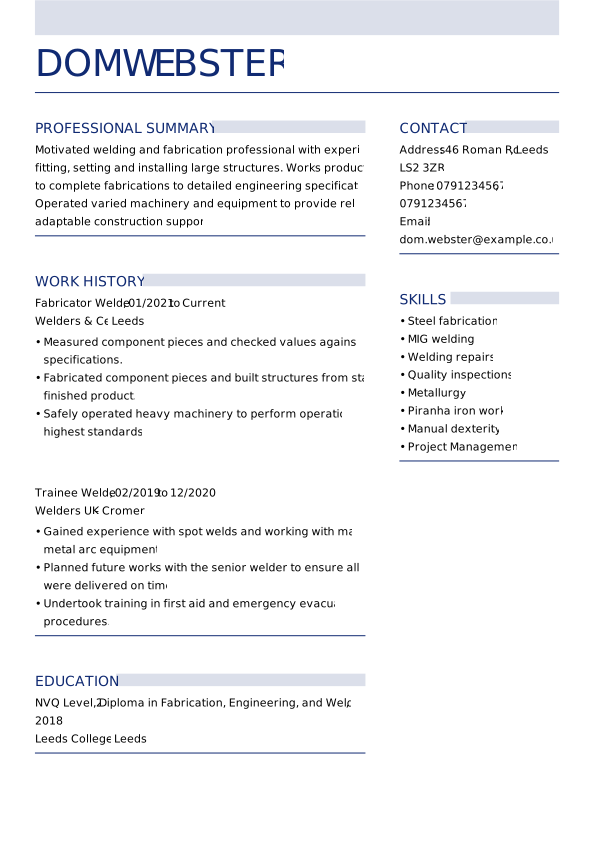
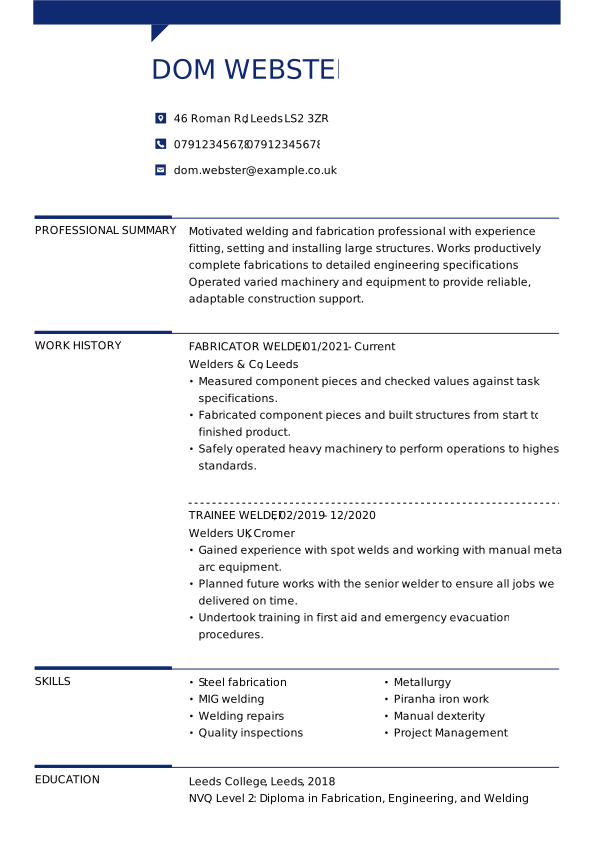
Starting on a fabricator welder CV is like preparing metal surfaces before a precise weld. You need to start with the right CV format, and the fabricator welder CV templates below can help.
MyPerfectCV builder has CV templates that allow you to present your qualifications, experience, and technical skills without the hassle of precise document formatting. Our fabricator welder CV templates ensure your CV passes ATS scans, stays easy to read, and maintains a professional appearance.
Select a template aligned with the hiring organisation’s style. A simple, clean design works well for traditional engineering firms or construction companies, whereas a more contemporary layout may be better for an innovative manufacturing startup or workshop.
Fabricator welder CV formats
Choosing the proper CV format will help you present all the necessary information clearly. Choose a chronological CV, as it’s the format most familiar to recruiters. It lists your roles from most recent to oldest, making it easier for recruiters to see your most relevant experience first.
Why a chronological CV format is right for a fabricator welder CV:
- It emphasises recent experience and professional growth: This format shows your career progression (for example, moving from apprentice to fully qualified fabricator welder) and the increasing responsibilities you’ve taken on over time.
- It is straightforward: Recruiters can quickly scan your work history, with job titles, dates, and achievements clearly listed under each role.
- It emphasises relevant roles: Putting your most recent welding position at the front makes it easier for your hiring managers to find.
On the other hand, a skills-based CV (also called a functional CV) highlights your abilities rather than your work history. This format can be useful if you’re changing careers or lack extensive welding experience. Use it with caution, as it could raise questions about your employment record.
If you opt for a skills-based approach, make sure to emphasise any welding training, certifications, or projects you have completed. Nonetheless, for most experienced fabricator welders, the reverse-chronological format will effectively showcase your practical expertise and career progress.
How to write a fabricator welder CV
Let’s look at how to prove you’re the best candidate by showcasing your relevant experience and specialised training. Here’s a step-by-step guide to crafting an excellent fabricator welder CV:
Open your fabricator welder CV with a header
The CV header is simple but crucial, so it must be impeccable. A single typo here can make it impossible for the recruiter to contact you.
Here’s what to include in your fabrication welder CV header:
- Full name and job title
- Location: include only your city.
- Phone number
- Professional email address
- LinkedIn or online portfolio: make sure your profile is up to date and professional.
Fabricator Welder CV header sample
Siobhan Keller
Fabricator Welder
Sheffield, UK
+44 7123 456 789
siobhan.keller.welder@mail.com
linkedin.com/in/SiobhanKeller
Write a personal profile for a fabricator welder CV
The personal statement is a brief yet strong introduction to your CV. Position this at the very top to highlight your fabrication and welding expertise and engage the recruiter to continue reading.
Here’s how to craft your fabricator welder CV profile:
- Start by stating who you are: Give your job title and years of experience.
- Emphasise areas of expertise: Mention your welding and fabrication specialities, such as MIG, TIG, arc welding, structural steel, pipe welding, or specific metals.
- Note experience in specific industries: Highlight your area of expertise, such as automotive, aerospace, or construction.
- Prove your impact with numbers or concrete outcomes: Quantify your achievements to grab attention, like completed projects, productivity improvements, or quality metrics.
- Finish with how you’ll help the employer: Align your statement with the employer’s needs. Indicate what you’re looking for and how your skills can benefit the organisation.
Example of personal statement for a fabricator welder CV
Skilled fabricator welder with 10+ years’ experience in industrial manufacturing and construction projects. Proven track record of delivering high-quality welds and fabrications under tight deadlines. Improved workshop productivity by 15% through a jig redesign while maintaining a 100% pass rate on weld inspections. Proficient in MIG, TIG and arc welding, blueprint interpretation, and heavy machinery operation, paired with a strong safety record (zero lost-time incidents in 5 years). Now seeking to bring my precision and efficiency to a new team, contributing to reliable, top-standard metalwork at Lylo organisation.
Highlight professional experience on a fabricator welder CV
The work experience section is the heart of your CV. It’s much like setting up a precise fabrication: the quality of each cut and weld determines the strength of the final structure. Similarly, outlining clear, impactful outcomes helps employers see the value you can bring to their team.
Here’s how to strengthen your experience section:
- Use a clear layout for each role: Start with your job title, the employer’s name, and the location, followed by the dates of employment
- List 3–6 bullet points of achievements and responsibilities under each job: Begin each bullet with an action verb and then describe your accomplishment or duty
- Tailor the details to the job description: Read the job advert and mirror its key requirements in your experience bullets
- Highlight variety and avoid repetition: Each bullet should present a different aspect of your skills or accomplishments
- Omit irrelevant or very old jobs: You don’t need to list every job you’ve ever had. Focus on the positions that make you a strong candidate for the welding job at hand.
Follow this with your earlier roles in the same format, listing job title, company, dates, and a bulleted list of key achievements. For example, a previous position as an “Apprentice Welder” or “Trainee Fabricator” would be listed next with its own dates and bullets.
Sample work experience entry for a fabricator welder CV
Fabricator Welder
SteelCraft Engineering Ltd, Sheffield
Jan 2015–Present
- Fabricated and welded complex steel assemblies for large industrial equipment and structural frameworks, completing approximately 20 units per month with less than 1% rework needed.
- Read and interpreted detailed engineering blueprints and CAD drawings to build products to exact specifications, working closely with engineers to resolve design-for-manufacture issues.
- Introduced improved welding techniques and fixture setups that cut production time by 15% and enhanced weld consistency, earning commendation from management for process improvement.
- Maintained strict adherence to safety protocols and quality standards (ISO 9001 environment), contributing to a 5-year zero accident record and excellent audit results.
- Mentored and supervised a team of 3 junior welders and apprentices, providing training on MIG/TIG welding best practices and equipment maintenance.
Mention education on your CV for a fabricator welder
A fabricator welder’s education section shows the foundation for their technical skills. In this section, list your relevant qualifications and any formal training that contributes to your welding expertise.
In the UK, many fabricator welders come through vocational routes such as apprenticeships, college courses, or military training rather than traditional university degrees. Typical qualifications might include a Level 2 or 3 Diploma/NVQ in Fabrication and Welding, apprenticeships in welding or engineering manufacture, or related technical certificates.
For each education entry, include:
If you are newly qualified or have limited work experience, you might add a bit more detail under your education entries, such as mentioning key modules or topics (e.g. “Coursework included MIG/TIG welding techniques, metal fabrication theory, and engineering drawings”) or any academic honours.
- Qualification name and level
- Institution and location
- Dates or year of completion
Fabricator welder CV education example
Level 3 Diploma in Fabrication and Welding Engineering (City & Guilds)
City College Leeds
2011–2014
BTEC National Diploma in Mechanical Engineering
Leeds College
2009–2012
List the most relevant fabricator welder CV skills
Your CV’s skills section should include a balance of hard skills and soft skills. Aim for about 6–10 key skills that are highly relevant to the role, and always tailor them to the job description. If the posting asks for specific welding processes or machinery experience, make sure they appear on your skills list.
Sample hard welding skills are:
- Welding processes expertise
- Blueprint and technical drawing interpretation
- Metal fabrication techniques
- Material knowledge
- Quality control and inspection
- Equipment maintenance and setup
- Health, safety, and compliance knowledge
Sample soft skills for welders include:
- Attention to detail
- Problem-solving abilities
- Teamwork
- Communication skills
- Time management and reliability
- Physical stamina and safe working habits
- Adaptability and willingness to learn.
You can list your skills in a simple bullet-point format or separated by commas in a line. Make sure they are specific (e.g. “Blueprint reading” rather than a vague “technical skills”). Here’s an example of how a skills section might look:
Fabricator Welder key skills:
- MIG, TIG and Arc Welding Techniques: Proficient in multiple welding processes, enabling you to work with different metals, joint types and production requirements.
- Blueprint Reading & Metal Fabrication Planning: Ability to interpret technical drawings and plan fabrication steps accurately, ensuring components are built to specification.
- Operating Cutting Tools (Oxy-Fuel, Plasma) and Workshop Machinery: Competent in using cutting equipment and machinery to shape, cut and prepare metal safely and efficiently.
- Weld Inspection & Quality Control Methods: Skilled in checking weld integrity using visual inspection and measurement tools, helping maintain high production standards.
- Safety Compliance (PPE, Risk Assessments, HSE Regulations): Strong understanding of workplace safety requirements and adherence to health and safety regulations to minimise risks on the job.
- Equipment Maintenance and Troubleshooting: Capable of maintaining welding equipment and identifying issues quickly to reduce downtime and ensure consistent weld quality.
- Attention to Detail and Precision: Focused on accuracy in measurements, weld placement, and finishing to produce high-quality, reliable components.
- Teamwork and Communication on the Shop Floor: Works well with colleagues, communicates clearly with supervisors and other trades, and contributes to a smooth, coordinated workflow.
Add extra sections to your fabricator welder CV
Once you’ve covered the basics, consider whether additional sections could strengthen your CV. Extra sections are optional, but they can showcase achievements or qualifications that don’t fit neatly elsewhere. They also demonstrate your commitment to the trade beyond just clocking in and out.
Extra sections you might include on a fabricator welder CV:
- Certifications: List industry certifications, safety qualifications, and process credentials in a separate section.
- Professional memberships: Membership in industry organisations like TWI or IOM3 show professional engagement.
- Awards and recognition: For example, being “Apprentice of the Year” or receiving an internal award shows your skills and work ethic to employers.
- Projects or notable accomplishments: Mention one or two standout projects, especially high-profile ones like landmark buildings, bridges, or machinery for major clients.
- Volunteer work or community involvement: It shows passion, goodwill, and community engagement.
- Languages: It can be an asset, especially in companies with diverse teams or international projects.
Structure these extra sections with a heading and list items in bullet points or a brief list format. Prioritise the extras that most strengthen your application.
Sample additional sections for a fabricator welder CV:
Certifications
- BS EN ISO 9606-1 Certified Welder: Qualified for MMA (Stick), MIG/MAG and TIG welding processes (obtained 2018)
- CSCS Skilled Worker Card: Construction Skills Certification Scheme, valid until Dec 2025
- First Aid at Work Certificate: St. John Ambulance, achieved 2021 (active)
Awards
- Employee of the Year (2022) – SteelCraft Engineering Ltd. Recognised for outstanding quality workmanship and productivity.
Apprentice Welder of the Year (2014) – City College Leeds. Received for top performance in practical assessments and teamwork during the apprenticeship program.
Format your fabricator welder CV
Even with great content, a CV can be let down by poor formatting. A hiring manager should be able to read your CV quickly and easily. Sloppy or confusing formatting can suggest a lack of organisation.
Here’s how to keep your CV professional:
- Font and text: Use simple, readable fonts like Arial, Calibri, or Times New Roman. Main text should be 10–11 pt, with section headings and your name in 12–14 pt or bold.
- Spacing: Use 1.15 or 1.2 line spacing for readability with ample white space.
- Margins: Maintain margins of 1.5 cm to 2.5 cm on all sides.
- Bullets: Use bullet points for duties, skills, or achievements to break up text into digestible pieces.
- Length: Aim for a two-page CV to cover key points without overwhelming.
- File format and name: Save your CV as a PDF for submission, unless the job advertisement specifies a different format.
- Name the file professionally: Include your name, job title, and the word CV.
- No fancy graphics: Keep the CV text-based and minimalist.
Remember: good formatting demonstrates professionalism and attention to detail, which are qualities every good fabricator welder should have.
Top dos and don’ts for a fabricator welder CV
Let’s see some of the most important do’s and don’ts you should keep in mind when working on your CV:
Adjust your CV for different jobs by highlighting the most relevant experience and skills. Using keywords from the job description will help.
Numbers and concrete outcomes make your accomplishments real.
Employers value well-rounded workers who collaborate, follow instructions, and adapt to challenges.
A concise, focused CV is better than a long, unfocused one.
A typo-free CV looks professional and shows attention to detail. Have someone review or read it aloud to catch mistakes.
Avoid bland statements like “Did welding and fabrication tasks.” Instead, highlight what you achieved, e.g., “Welded and assembled 10 aluminium frames weekly with 100% X-ray pass rate, contributing to a major construction project’s on-time completion.”
Highlight technical skills like MIG, TIG, CNC, NDT, but remember the first reader may be HR with limited technical knowledge.
Focusing solely on technical skills neglects traits like teamwork, reliability, and safety awareness.
In the UK, it’s standard not to put a photo or personal details on your CV.
Avoid using bright colours, elaborate fonts, images, or complex graphics on your CV.
Frequently asked questions about fabricator welder CVs
What is fabrication?
Fabrication is the process of turning raw materials – typically metal – into finished components, including electrical equipment, household objects, toys, and more. A fabricator might produce single parts for a product or every element. The complex work occurs in factories, specialist shops, and construction sites.
What does a fabricator welder do?
The day-to-day duties of a fabricator welder depend on the project and place of work. However, there are a few crossovers, including:
- Creating metal components for products
- Interpreting engineering plans, drawings and instructions
- Overseeing the best health and safety practices
- Confidently using various power tools
- Using computer software to design structures
What skills do welders need?
Welders need a wealth of hard and soft skills to excel in their position. We’ve mentioned many of the hard skills above, so let’s explore the latter:
- Ability to work within tight deadlines
- Enthusiastic learner and team player
- A knack for mathematics and engineering
- Keen attention to detail
- Excellent communicator
How much does a welder make?
How much welders make depends on experience and location. However, most welders in the UK can expect somewhere between £25,000 to £35,000 per year. Of course, this increases as you gain more specialist skills or take on extra responsibilities, like training team members or overseeing projects.
Related Construction CV Examples
- Site Supervisor CV Example
- Property manager CV example
- Build your career with our construction manager CV examples
- Build an outstanding application with our construction worker CV example
- Scaffold Builder CV Example
- Real Estate Assessor CV Example
- Estate agent CV examples, templates & guide
- Best Project Manager CV Example & Writing Guide
- Ground Worker CV Example
- Nail your application with our perfect builder CV example

Create a fabricator welder CV that stands out from the crowd
This fabricator welder CV sample is only a single version of the many examples available which afford key insights into the process of writing a new CV. Anyone seeking a job should also look into our tools and CV builder for additional valuable advice.
Other professional CV examples will give you bundles of ideas on completing each CV section. Or head to the online builder to choose a pre-made CV template that’s ideal for fabricator welder roles. You can then search for related jobs to find content that’s relevant and ready to go for your CV.