

Monitoring and Evaluation Officer CV + Examples
Measure organizational impact and advance your career. Build a professional monitoring and evaluation officer CV that highlights your analytical skills and lands more interviews today.

- Our customers have been hired by : *Foot Note
The functions of monitoring and evaluation officers are distinct from those of any other role within an organisation. That’s why your monitoring and evaluation officer CV needs to clearly demonstrate the skills, experience, and qualifications required for the role.
Our sample CV for monitoring and evaluation officers can serve as a guide for your CV-building process. Discover everything you need to know about monitoring and evaluation officer skills, responsibilities, and key achievements, then get started on your own CV with pre-made CV templates and an easy-to-use online CV builder.
Smarter writing with built-in AI
Get instant, high-quality text suggestions tailored to your specific industry.
SEARCH ALL CV EXAMPLES
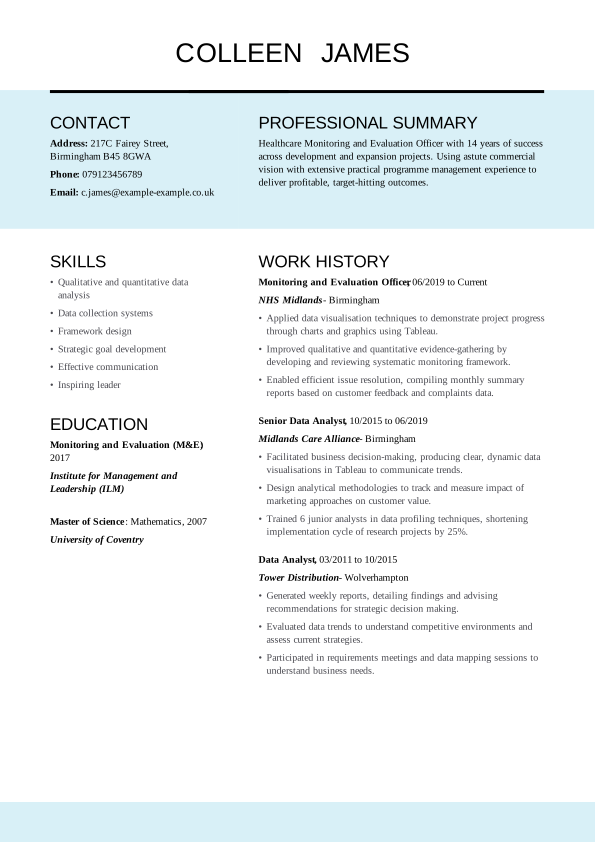
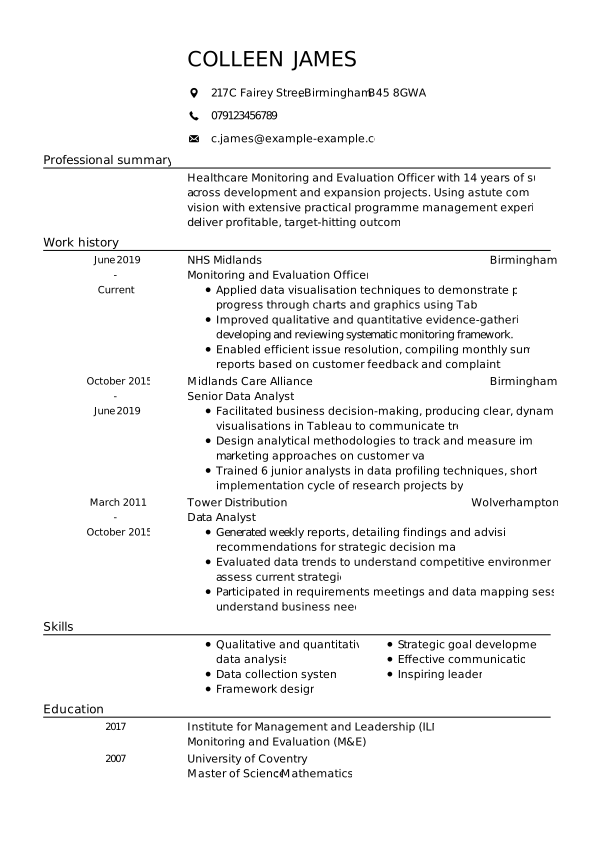
Monitoring and evaluation officer CV example
COLLEEN JAMES
Birmingham
079123456789
c.james@example-example.co.uk
PROFESSIONAL SUMMARY
Healthcare Monitoring and Evaluation Officer with 15 years of success across development and expansion projects. Using astute commercial vision with extensive practical programme management experience to deliver profitable, target-hitting outcomes.
WORK HISTORY
June 2019 – Current
Monitoring and Evaluation Officer – NHS Midlands
Birmingham
- Applied data visualisation techniques to demonstrate project progress through charts and graphics using Tableau.
- Improved qualitative and quantitative evidence-gathering by developing and reviewing a systematic monitoring framework.
- Enabled efficient issue resolution, compiling monthly summary reports based on customer feedback and complaints data.
October 2015 – June 2019
Senior Data Analyst – Midlands Care Alliance
Birmingham
- Facilitated business decision-making, producing clear, dynamic data visualisations in Tableau to communicate trends.
- Design analytical methodologies to track and measure impact of marketing approaches on customer value.
- Trained 6 junior analysts in data profiling techniques, shortening implementation cycle of research projects by 25%.
March 2011 – October 2015
Data Analyst – Tower Distribution
Wolverhampton
- Generated weekly reports, detailing findings and advising recommendations for strategic decision-making.
- Evaluated data trends to understand competitive environments and assess current strategies.
- Participated in requirements meetings and data mapping sessions to understand business needs.
SKILLS
- Qualitative and quantitative data analysis
- Data collection systems
- Framework design
- Strategic goal development
- Effective communication
- Inspiring leader
EDUCATION
2017
Monitoring and Evaluation (M&E) – Institute for Management and Leadership (ILM)
2007
Master of Science: Mathematics – University of Coventry
Monitoring and evaluation officer CV templates
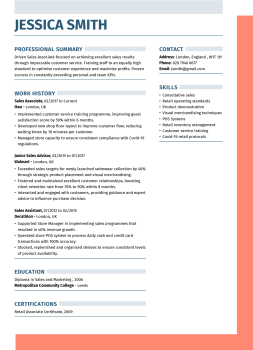
Creating a strong monitoring & evaluation officer CV is much easier when you begin with a solid foundation. Our professionally designed modern CV templates are tailored to the UK job market to help you effectively present your analytical skills, reporting experience, and evaluation expertise.
Whether you’re an entry-level M&E assistant or an experienced evaluation specialist, the right template ensures your achievements and technical abilities stand out. With a well-structured layout already in place, you can focus on showcasing your impact — not worrying about formatting.
Monitoring & evaluation officer CV formats
Choosing the right format for your monitoring and evaluation officer CV is an essential first step. It determines whether you highlight your analytical capabilities or showcase your progression through monitoring, reporting, and evaluation roles. The two most common CV formats for M&E professionals are the chronological and skills-based CVs.
The chronological CV is ideal for candidates with solid experience in monitoring and evaluation. This format lists your work history in reverse chronological order, making it easy for employers to see your career progression through growing responsibilities and expertise. Recruiters favour this format because it clearly shows how your analytical skills have developed over time.
A skills-based CV is best suited to career changers or early-career M&E professionals. This format allows you to focus on core competencies such as data collection, reporting, indicator design, and qualitative or quantitative analysis. It is especially useful if you’re entering M&E after working in research, project support, community programmes, or academia. Grouping your abilities under skill categories—such as data analysis, research methods, or monitoring frameworks—highlights relevance even without a long work history in formal M&E roles.
How to write a monitoring and evaluation officer CV for UK jobs
A strong monitoring and evaluation officer CV must demonstrate that you can measure progress, interpret data, and come up with reliable insights. Employers want evidence that you can create clear reports to aid their decision-making.
If that feels like a lot to communicate, don’t worry — I’ll walk you through each step of writing a CV for a monitoring and evaluation officer that is structured, impactful, and tailored to UK job standards.
Add your contact details first
It’s a critical part of your monitoring and evaluation officer’s CV. If a hiring manager can’t reach you quickly, your application may be overlooked. Keep this section professional, accurate, and clearly positioned at the top of your document.
Include:
- Your name – Use your full name in a clear, readable font.
- Job title – e.g., Monitoring & Evaluation Officer, Data & Evaluation Officer.
- Phone number – Your personal mobile number.
- Professional email – Preferably firstname.lastname@[provider].
- Location – Your city and county (no full address needed).
- LinkedIn profile – Make sure it’s up to date.
- Portfolio or dashboard links (optional) – Useful if you have Power BI dashboards, reports, or published evaluations.
Amira Patel
Monitoring & Evaluation Officer
Leeds, UK
Phone: 07123 987 654
Email: amira.patel@email.com
LinkedIn: linkedin.com/in/amirapatelME
Portfolio: amira-patel-analysis.com
Lead with a compelling personal profile
Your personal profile, also known as a CV summary, is your chance to make a strong first impression. In just 3–4 concise sentences, you should demonstrate analytical ability, reporting experience, familiarity with M&E tools, and your contribution to programme improvement.
To make your profile persuasive, focus on:
- Your relevant experience – number of years, sectors (NGO, government, charity, health, education), and types of projects you’ve evaluated.
- Quantifiable achievements – such as improving data accuracy, increasing survey response rates, or developing monitoring systems. Avoid vague claims and, when possible, provide statistics.
- Your value to the organisation – the impact you will deliver. Mention the hiring organisation’s name to show you’re tailoring your CV.
Results-driven Monitoring & Evaluation Officer with 5+ years’ experience designing data collection tools, analysing quantitative and qualitative datasets, and reporting on programme performance across international development and public sector projects. Improved KPI accuracy by 32% through enhanced monitoring systems and delivered actionable insights that strengthened decision-making for senior stakeholders. Seeking to bring methodological rigour and data-driven evaluation skills to Star Corp.
Avoid clichés such as “hardworking professional” or “results-oriented” without supporting evidence. Instead, use measurable statements to show your value. Write in third person and avoid personal pronouns like “I” or “my.”
Showcase your monitoring & evaluation work experience
Your work experience section is where you prove your ability to conduct monitoring and evaluation activities, interpret findings, and support programme improvement. Remember that organisations want to see impact, not just duties.
List your roles in reverse chronological order and include:
- Job title
- Organisation name and location
- Dates of employment (month/year)
- 4–6 impactful bullet points
How to write strong achievement bullet points:
- Use action verbs like analysed, developed, implemented, evaluated, validated, trained, and monitored.
- Always aim to quantify your results: sample sizes, survey response rates, number of projects supported, percentage improvements, time saved, or accuracy gained.
- Reflect the priorities in the job description. If the employer emphasises baseline surveys, KPI tracking, or stakeholder engagement, prioritise examples that match these areas.
Monitoring & Evaluation Officer
Community Impact UK, Birmingham
Mar 2021 – Nov 2025
- Designed and rolled out a monitoring framework across three major programmes, improving reporting consistency by 38%.
- Conducted baseline and endline surveys with 1,200+ participants, ensuring high-quality data collection and integrity.
- Led data analysis using Excel, SPSS, and Power BI, producing monthly dashboards for senior leadership.
- Delivered training sessions to 25+ staff members on survey tools and data entry, reducing reporting errors by 22%.
- Collaborated with programme teams to identify performance gaps and recommend evidence-based adjustments.
Present your education
Most monitoring and evaluation officer roles require a degree in a relevant field, particularly in the social sciences, research, statistics, public health, or development. If you have postgraduate qualifications, list them prominently. Early-career candidates can emphasise relevant coursework or dissertations involving research or data analysis.
Include:
- Qualification name
- University/institution
- Dates
- Relevant modules, research, or projects
MSc in Development Studies
University of Sussex
2018 – 2019
- Dissertation analysing the impact of cash-transfer programmes in East Africa using mixed-methods research.
BA in Sociology
University of Liverpool
2015 – 2018
- Modules in research methods, statistics, and social policy.
List your best monitoring & evaluation skills
A well-organised skills section helps hiring managers quickly identify your strengths and ensures your CV performs well in Applicant Tracking Systems (ATS). Balance hard skills (technical capabilities) with soft skills (behavioural and interpersonal strengths).
Hard skills for an M&E CV
- Quantitative data analysis
- Qualitative research methods
- KPI and indicator design
- SPSS / Excel / Power BI
- KoboToolbox / ODK Collect
- Baseline & endline survey design
- Logical Framework Approach (LogFrame)
- Impact evaluation
Soft skills for an M&E CV
- Critical thinking
- Data interpretation
- Stakeholder communication
- Report writing
- Problem-solving
- Time management
- Collaboration
- Presentation skills
Use 6–10 skills that match the job description and reflect expertise shown in your work experience.
Improve your M&E CV with bonus sections
Extra sections can help you stand out, especially in competitive fields such as international development, humanitarian work, and public-sector evaluation. They allow you to highlight specialised expertise beyond the standard requirements.
Popular bonus sections for an M&E CV include:
- Certifications – Show relevant professional training and gained specialised skills in monitoring, evaluation, data analysis, or project management.
- Languages – Useful for roles in international development or organisations working with multicultural communities.
- Professional memberships – Indicate your involvement in recognised evaluation networks or research associations.
- Awards & achievements – Highlight any recognition received for outstanding work to demonstrate credibility and impact.
- Publications – Include evaluation reports, research papers, articles, or case studies you’ve authored or contributed to.
- Conferences & workshops – Listing relevant events you’ve attended or presented at shows your commitment to continuous learning and staying informed about emerging evaluation trends and methodologies.
- Volunteer work – Useful if you’ve supported community projects, data collection, or evaluation activities outside your main job.
Certifications
- Monitoring & Evaluation for Development Projects – 2024, UNITAR
- Data Analysis with Excel & SPSS – 2023
- Theory of Change & LogFrame Methodology – 2022
Professional Memberships
- Member – UK Evaluation Society
- Member – European Evaluation Society
Format your monitoring and evaluation officer CV correctly
Even the most substantial achievements can be overlooked if your CV isn’t formatted well. Recruiters in M&E roles value clarity, structure, and accuracy—qualities reflected directly in your CV layout.
Formatting rules for an M&E CV:
- Font choice: Use clean, professional fonts like Arial, Calibri, or Helvetica.
- Font size: 10–12 pt for text; 14–16 pt for headings.
- Margins: 1.5–2.5 cm for a clean, balanced layout.
- Length: 1–2 pages, depending on experience.
- Spacing: Use 1.15–1.5 line spacing for readability.
- File format: Save as PDF unless requested otherwise.
A well-formatted CV shows attention to detail, an essential trait for monitoring and evaluation roles. It also mirrors the structured, analytical approach that employers expect from M&E professionals.
Dos and don’ts for a monitoring and evaluation officer CV
Highlight the evaluation tools, analysis techniques, and programme areas most relevant to the job description. Align your CV with the organisation’s sector.
Use data to demonstrate your impact, such as “improved data accuracy by 25%,” “designed indicators for a £1.2M programme,” or “conducted surveys with 800+ beneficiaries.”
Use clear headings, bullet points, and consistent formatting. A well-organised CV demonstrates the attention to detail expected in M&E roles.
Employers want to see specific software: Excel, SPSS, Power BI, KoboToolbox, ODK, SurveyCTO, or other data platforms. Mention your level of proficiency where applicable.
M&E officers must interpret data and present it clearly.
Terms like “methodological synergy” or “complex adaptive systems” can obscure your actual contributions. Keep language clear, concise, and accessible.
Instead of writing “responsible for data collection,” show impact: “collected and validated field data, improving reporting reliability by 30%.”
Communication, stakeholder engagement, time management, and problem-solving are crucial for M&E roles. Balance technical expertise with interpersonal strengths.
Employers value clarity and efficiency. Keep your content focused on relevant achievements, methods, and tools.
Each programme, donor, or sector has different reporting expectations. Tailor your CV to reflect the skills and methodologies that align with each organisation’s needs.
Top FAQs about your monitoring and evaluation officer CV
What does a monitoring and evaluation officer do?
As the job title suggests, monitoring and evaluation officers are responsible for monitoring and evaluating the success of a project (or several projects) within an organisation. They are tasked with designing, implementing, and managing the systems used to monitor and evaluate progress with a view to assisting the project manager.
What are the duties of a project monitoring, evaluation and reporting officer?
One of the core monitoring and evaluation officer responsibilities is setting up a framework to continually monitor the progress of a project. That calls for specific quantitative and qualitative data which can be tracked and reported on. Officers then need to take charge of the monitoring process, collecting data, reporting on progress, and training staff or partners as required. They may also need to make recommendations for improvements during or following the completion of each project.
What are the skills of a monitoring and evaluation officer?
Analysis, assessment, and reporting are amongst the most important monitoring and evaluation officer skills. You need to be a natural problem solver, who’s decisive and very well organised, with a comprehensive knowledge of the most suitable assessment methodologies and how to implement them. Leadership skills are also important to manage the data collection and entry process and all staff involved.
How much does a monitoring and evaluation officer earn?
Monitoring and evaluation officers usually earn upwards of £30,000 in the UK. This can easily rise to around £40,000 at larger companies or public sector organisations, where you’ll be evaluating projects on a national or even international scale.
How do I start a career in monitoring and evaluation?
Monitoring and evaluation officers are mostly degree-educated. While there’s no dedicated degree for monitoring and evaluating, a business or mathematical subject is a good start. That can be complemented by specific monitoring and evaluation courses as you work your way up in data analyst or researcher roles.
Related Administration CV Examples, Templates, and Samples for 2026
- Tender CV Example
- Bank Compliance Officer CV Example
- Managing director CV examples
- Process Improvement Consultant CV Example
- HR officer CV examples
- Personal assistant CV examples UK
- Project support officer CV example
- Chief operating officer - COO CV examples
- Duty manager CV examples
- Executive assistant CV examples UK

Take the guesswork out of your monitoring and evaluation CV
As a monitoring and evaluation officer, you’re always on the lookout for a tried-and-tested approach. That’s exactly what myPerfectCV offers when it comes to your CV.
Alongside our sample CV for monitoring and evaluation officer roles, we have a selection of customisable templates and pre-written content in our online builder.
From the professional summary to your monitoring and evaluation officer skills, we’ll make sure you’re on the right track for success. Get started today with MyPerfectCV’s CV maker for free!
*The names and logos of the companies referred to above are all trademarks of their respective holders. Unless specifically stated otherwise, such references are not intended to imply any affiliation or association with myperfectCV.