
How to Write a Chef CV: Example, Template & UK Guide
Showcase your culinary passion and land your next role. Build a professional chef CV that highlights your kitchen expertise and secures more interviews today.

- Our customers have been hired by : *Foot Note
Our recruiter-approved chef CV example shows you how to go beyond listing past roles and responsibilities. We’ll guide you on how to create a CV that demonstrates the real value you’ve brought to each venue, from flavour to financial impact.
Smarter writing with built-in AI
Get instant, high-quality text suggestions tailored to your specific industry.
SEARCH ALL CV EXAMPLES
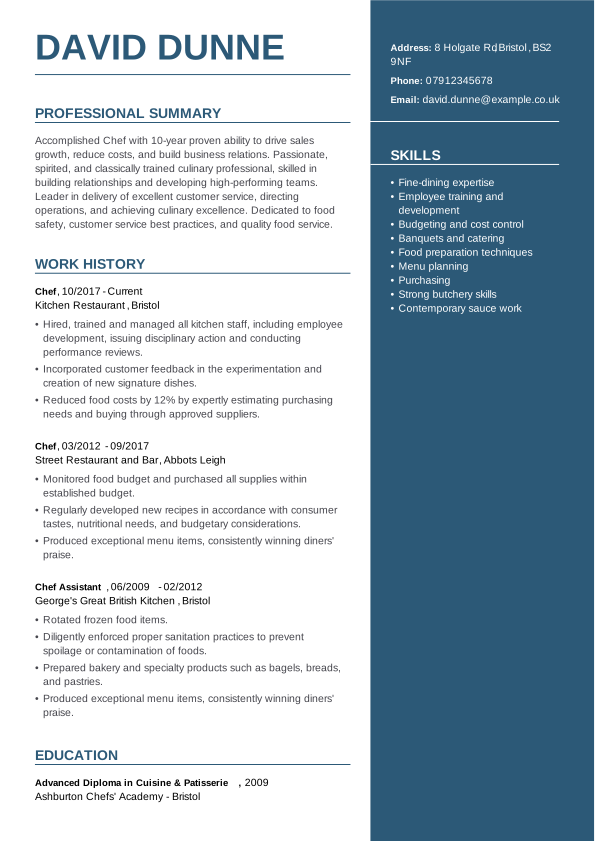
Chef CV example
Oliver Graham
Head Chef
London, UK
Phone: 07700 900555
Email: oliver.graham@example.com
LinkedIn: linkedin.com/in/olivergrahamchef
Personal Profile
Innovative Head Chef with 7+ years of experience in fine dining and gastro-pub kitchens. Adept at crafting seasonal menus and leading brigades with a pinch of creativity and discipline. At The Gourmet Garden (Michelin-starred restaurant), led a 15-chef team to maintain a Michelin star for 3 years consistently and boosted guest satisfaction by 30%. Seeking to stir up delectable cuisine and operational excellence at a high-end London establishment.
Work Experience
Head Chef
The Gourmet Garden, London
June 2019–Present
- Spearheaded kitchen operations for a 50-cover fine dining restaurant, managing a brigade of 15.
- Whipped up a new farm-to-table menu that increased weekly reservations by 25% and earned 2 AA Rosettes for culinary excellence.
- Trained and mentored five junior chefs, garnishing the team with a culture of high standards.
- Optimised inventory and supplier contracts, reducing food costs by 18% and food waste by 40%.
Sous Chef
The Red Lion Gastropub, Oxford
April 2016–June 2019
- Assisted the Head Chef in menu planning and daily kitchen prep for a 100-seat gastropub, ensuring quality and consistency during peak services.
- Introduced seasonal menu specials that boosted revenue by 15% and received positive local press reviews.
- Supervised a kitchen team of 8 and improved order-to-table times by 20% through better mise en place and workflow.
Education
City & Guilds Level 3 NVQ Diploma in Professional Cookery
Ashburton Chef’s Academy, Bristol
2014
- Graduated with distinction; completed 300+ hours of hands-on kitchen training.
Key Skills
- Menu Development
- Knife Skills
- HACCP & Food Safety Compliance
- Team Leadership
- Budget & Waste Control
- Calm Under Pressure
- Communication
- Attention to Detail
Certifications
- Level 2 Award in Food Safety & Hygiene (CIEH), 2018
- HACCP Level 3 Certified, 2018
Awards and memberships
- Winner, UK Young Chef of the Year 2018 – Recognised by the Craft Guild of Chefs.
- Member, Craft Guild of Chefs (UK) – Active since 2019, participating in annual culinary competitions and workshops.
Languages
- English (Native)
- French (Fluent) – leveraging French cuisine training to bring classical techniques to the kitchen.
Chef CV templates
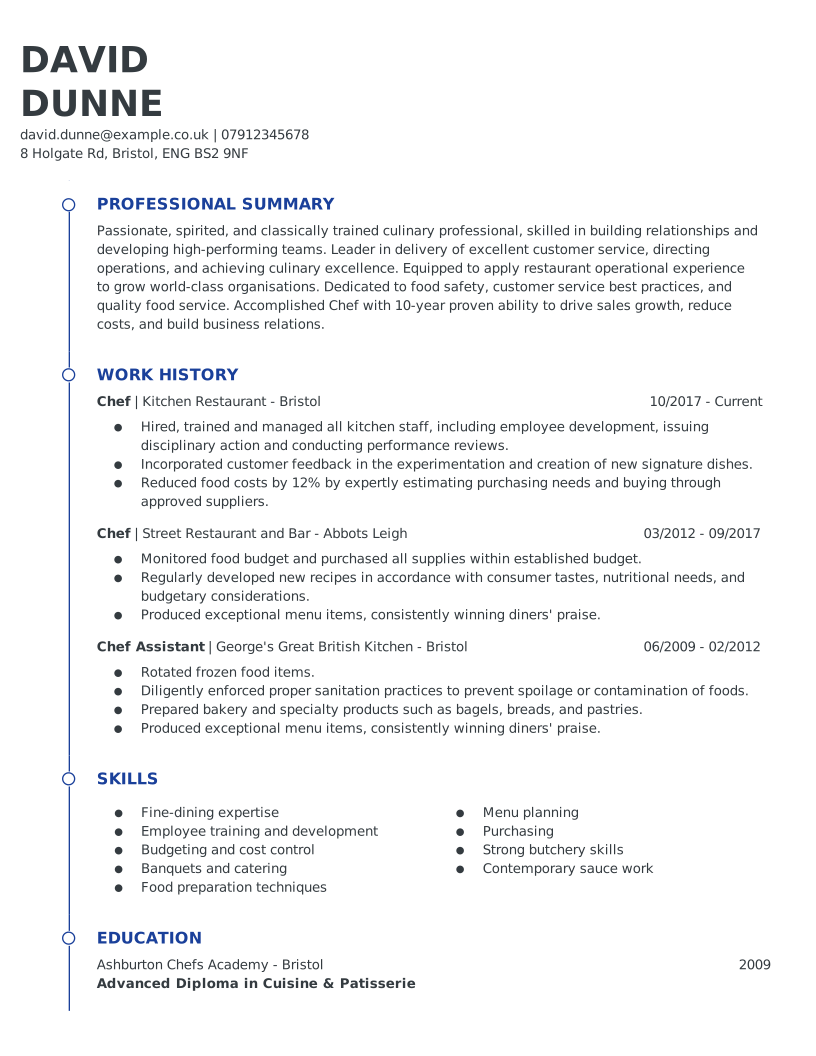
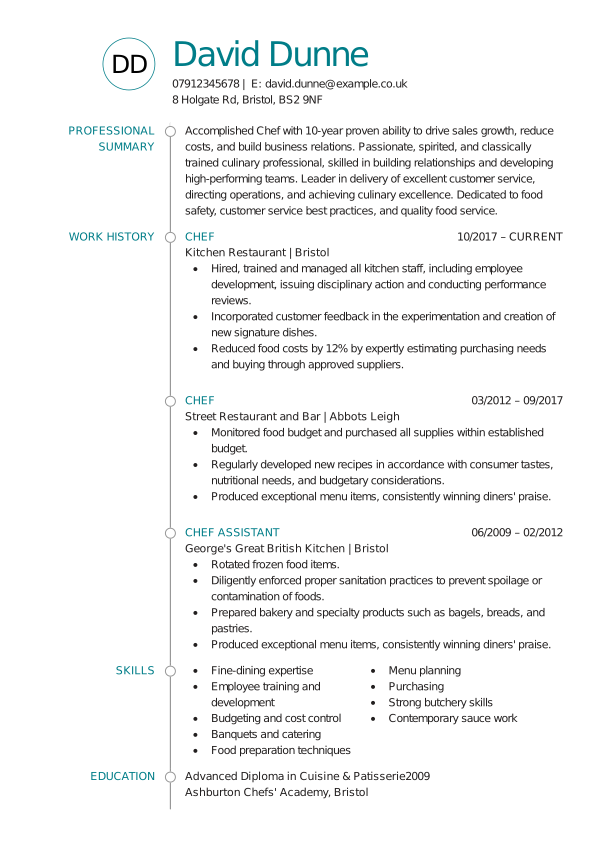
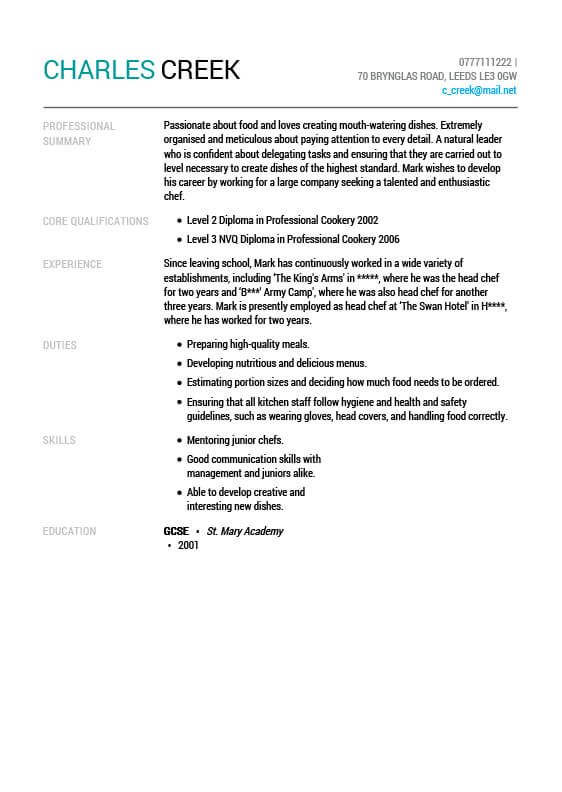
Creating an ideal chef CV always starts with choosing the correct layout. A properly crafted template makes it easier for you to showcase your achievements, background, and skills. Our UK chef CV templates are designed to pass ATS scans, remain easy to read, and are 100% professional.
The best format for your chef CV
When creating a chef CV, choosing the proper CV layout is essential to showcase both your culinary talent and kitchen leadership. A reverse chronological CV format is ideal for chefs with a steady progression in the hospitality industry. It lists your most recent or current job first, helping employers assess your career progression and key responsibilities.
If you’re changing careers or have gaps in your employment history, a skills-based CV format can highlight your cooking techniques, creativity, and teamwork without overemphasising your timeline.
How to write a chef CV
Let’s start creating your chef CV. We’ll start from the header and cover each section, including additional ones. In each, we’ll focus on proving you’re the best fit for the role you’re after.
- Include necessary contact information in the chef CV header
- Start with a chef CV personal profile
- Create a tasty work experience section on your chef CV
- Show your education and training on a CV for a chef
- Highlight your key chef skills on a CV
- Add bonus sections to make your CV stand out even more
- Format your chef CV correctly
Include necessary contact information in the chef CV header
The header of your chef CV should be presented like a clean nameplate at the top of a menu. Include the following:
- Full name: Make it bigger, so that it’s impossible to miss and to forget.
- Professional title: Tailor it to the role. If you’re a Head Chef, Sous Chef, Chef de Partie, etc., list your position below your name to show your level immediately.
- Contact details: That’s what you surely don’t want your recruiter to miss. Include a phone number and a professional email.
- No unnecessary personal info: Stick to basics. Do not list age, date of birth, marital status, or full address. UK employers don’t require these, and including them can seem out of place (or lead to biased concerns).
- No photo (for UK CVs): Unlike in some countries, it’s generally not recommended to include a profile photo on your UK CV. Cheffing is about your skills and experience, so let those ingredients shine, rather than a headshot.
- Optional extras: If you have a professional website or online portfolio (say, a gallery of your plated dishes), you can include the link. Just make sure it’s relevant and adds flavour to your application.
Example (chef CV header)
Oliver Graham
Head Chef
London, UK
Phone: 07700 900555
Email: oliver.graham@example.com
LinkedIn: linkedin.com/in/olivergrahamchef
Start with a chef CV personal profile
Your personal profile is like an amuse-bouche: a brief taste of your best qualities to make the recruiters hungry for more. This is the place to infuse a bit of your culinary personality and passion. Make it count and they’ll read on!
Tips to stir in when writing your profile:
- Start with a descriptor and role – e.g. “Creative pastry chef with 5+ years’ experience…”. An adjective + your chef title + years of experience serves perfectly well.
- Mention your cuisine specialities or key strengths. Do you shine in Italian cuisine, pastry arts, farm-to-table cooking, or high-volume banquet service? Highlight that niche.
- Sprinkle in one or two quantifiable accomplishments to prove your value. Concrete metrics (savings, increases in revenue or customer satisfaction, awards won) will only prove your professionalism and attention to detail.
- Finish with what you’re aiming for in this next role or how you will benefit the employer. Tailor this to the specific job posting if possible, to show you’re the perfect fit for their kitchen.
- Keep the tone professional yet passionate. Let your love for cooking come through without sounding too flowery.
And while culinary puns are fun, use them more sparingly here; you want to be taken seriously as a candidate with a dash of personality, not come off as gimmicky.
Chef CV personal profile example
Innovative Head Chef with 7+ years of experience in fine dining and gastro-pub kitchens. Adept at crafting seasonal menus and leading brigades with a pinch of creativity and discipline. At The Gourmet Garden (Michelin-starred restaurant), led a 15-chef team to maintain a Michelin star for 3 years consistently and boosted guest satisfaction by 30%. Seeking to stir up delectable cuisine and operational excellence at a high-end London establishment.
Create a tasty work experience section on your chef CV
Your work experience is the main course of your CV – it needs to be satisfying and full of substance.
Structuring each job entry:
- Job title, venue, dates: Example – “Head Chef – The Gourmet Garden, London — July 2019–Present”. Include the restaurant type if not obvious (e.g. “fine dining 80-cover restaurant” or “5-star hotel brasserie”) to give context.
- Key responsibilities: Describe your actions in bullet points using strong verbs like led, created, managed, supervised, increased, reduced, launched. Include leadership duties (managing brigades, training staff), menu development, kitchen operations, and roles like budgeting or catering.
- Achievements with metrics: This key strategic element links responsibilities to achievements and data. Show how you’ve improved efficiency, food quality, revenue, customer ratings, reduced costs, or earned awards. Include measurable results, as numbers attract restaurant managers reviewing your CV.
When writing about your experience, tailor it to the job you’re applying for. For example, if the advert emphasises banquet experience and you possess it, ensure your relevant past role highlights the significant events you catered. Each bullet should answer the question: how did this improvement to the kitchen or business enhance it? This approach demonstrates your understanding of business needs, not just recipes.
Chef CV work experience example
Head Chef
The Gourmet Garden, London
2019–Present
- Spearheaded kitchen operations for a 50-cover fine dining restaurant, managing a brigade of 15.
- Whipped up a new farm-to-table menu that increased weekly reservations by 25% and earned 2 AA Rosettes for culinary excellence.
- Trained and mentored five junior chefs, garnishing the team with a culture of high standards.
- Optimised inventory and supplier contracts, reducing food costs by 18% and food waste by 40%.
Show your education and training on a CV for a chef
In the culinary industry, practical experience often outweighs formal qualifications. Nevertheless, your education and training section remains important to demonstrate your core cooking knowledge and certifications. Include your academic qualifications, culinary school diplomas, and any relevant training courses or apprenticeships here.
Here’s what to include:
- Culinary school or college courses: If you attended a culinary institute or took professional cookery courses, list the degree, diploma, or certificate name, the institution, and the year completed.
- Apprenticeships or on-the-job training: Many UK chefs start as apprentices or through trainee programmes. You can include an apprenticeship under education if it was a formal program, as this shows structured training.
- Certifications: You might break this into a separate section, but shorter courses or certifications can be mentioned in education too. Key ones include food safety and hygiene courses, allergy awareness, first aid, and any specialised cuisine courses. These demonstrate continuous learning and compliance with UK standards.
- Secondary education: Generally, there’s no need to list your GCSEs or A-levels unless you have little else to show. If you’re an entry-level chef, you can mention any relevant subjects (like Food Technology). Otherwise, focus on culinary-specific education.
If you lack formal culinary education, don’t worry, your experience can easily compensate. Still, show any professional development you’ve pursued. Even a short course or workshop can be a nice extra garnish in this section, indicating passion for honing your craft.
Chef CV education section example
City & Guilds Level 3 NVQ Diploma in Professional Cookery
Ashburton Chef’s Academy, Bristol
2014
- Graduated with distinction; completed 300+ hours of hands-on kitchen training.
Highlight your key chef skills on a CV
Just as every great recipe has essential ingredients, every great chef CV has a key skills section. This is where you list the competencies that make you a seasoned chef and an effective employee. Just remember to include both hard and soft skills. Otherwise, this section will feel incomplete.
Hard Skills:
- Culinary techniques: expert knife skills, butchery, baking, pastry arts, sauce-making, grilling, sous-vide cooking, plating and presentation.
- Menu planning & recipe development: creating dishes and full menus that balance taste, cost, and creativity.
- Food safety & hygiene: knowledge of HACCP protocols, food storage standards, allergen management, and maintaining a clean kitchen.
- Kitchen management: stock ordering, inventory control, reducing waste, managing food cost and budgeting, scheduling staff, coordinating with suppliers.
- Cuisine specialisations: e.g. French cuisine, Italian cuisine, Japanese sushi, vegan/vegetarian cuisine, pastry and desserts, etc. Match these to the job’s style if you can.
Soft skills:
- Leadership & teamwork: ability to lead a kitchen brigade, train junior chefs, and collaborate with front-of-house managers. Chefs are often leaders, so mention mentoring or team coordination experience.
- Time management: handling multiple orders under pressure, prioritising tasks for efficient service. A calm, organised chef can deliver dozens of dishes on time even at peak rush.
- Communication: clearly giving instructions to your team, and listening to feedback from staff and customers. In a busy kitchen, communication is as essential as chopping skills.
- Creativity & adaptability: improvising with ingredients, adjusting menus for dietary needs, and staying creative under constraints. Also, adapting to seasonal changes or last-minute challenges (like a supplier issue) shows resilience.
- Attention to detail: from plating perfectly to spotting when a sauce needs seasoning, chef’s ensures quality and consistency.
- Calm under pressure: the kitchen rush can reach boiling point; highlighting that you can keep cool and focused during the dinner rush is a big plus. Employers value chefs who don’t “flip their lid” when the tickets pile up.
Add bonus sections to make your CV stand out even more
A basic CV might be just experience, education, and skills – but an extraordinary chef CV includes those little extras that can tip the scales in your favour. To really add a garnish that makes your CV stand out, consider including additional sections for any extra achievements or credentials.
Here are some bonus sections you can add:
- Certifications: If not already covered under education, list any professional certifications. Common ones in the UK culinary scene include Food Safety Level 2 or 3, Health and Safety Certificates, First Aid, and any speciality courses (e.g. a WSET wine certification if relevant for a chef-sommelier role).
- Awards: Have you won or been nominated for any accolades? This could range from competition wins to local awards. If you played a key role in your restaurant earning prestigious awards, like Michelin stars or AA Rosettes, mention that too.
- Memberships: Joining culinary associations can demonstrate your commitment to the field. In the UK, the Craft Guild of Chefs, the British Culinary Federation and international groups like WorldChefs make a great impression.
- Languages: If you speak other languages, especially useful ones in kitchens (French is the language of cuisine, Spanish is common in many kitchens, Italian for Italian cuisine, etc.), list them with proficiency level. In cosmopolitan cities or luxury hospitality, an extra language can be a bonus for communicating with diverse staff or reading international recipes.
- Culinary competitions: Even if you didn’t win, participation in well-known contests (MasterChef, Great British Menu, local cook-offs) is worth noting. It shows passion and that you thrive under pressure.
- Publications: If you’ve been featured in the media, or if you write a food blog or have published a cookbook, you can include a line about it. These can impress employers, as they indicate thought leadership or at least that your work has public recognition.
- Volunteer work or community involvement: Perhaps you volunteer at food banks, teach cooking classes to youth, or participate in charity cook-off events. A brief mention shows character and community spirit.
- Hobbies and interests: Food photography or food-travelling count as something relevant and can show your cultural culinary exposure.
Format your chef CV correctly
Great plating makes a dish instantly appealing; in the same way, good formatting makes your CV inviting to read. Recruiters and restaurant owners are often busy (and may have stacks of CVs to sift), so a well-formatted CV can make your information easy to digest at a glance. Here are some chef-style precision tips for CV layout and design in the UK:
- Aim for no more than two pages in length for a CV. Concise is key. Junior chefs or commis chefs might even keep it to 1 page if experience is limited. You want to leave the hiring manager satisfied, not stuffed with irrelevant details.
- Use a clean, professional CV font (Arial, Calibri, Garamond, etc.) at a readable size – roughly 10–12pt for body text and a bit larger (14–18pt) for section headings. Avoid overly fancy or “handwriting” fonts; your CV isn’t a menu logo.
- Ensure there’s sufficient white space (margins of about 1 inch) so it doesn’t look overcrowded. A cluttered CV is like a cluttered workstation: hard to work with.
- Clearly label each section with bold or slightly larger text. Use consistent styling for all headings.
- Send your CV as a PDF file and give the file a clear name like ChefCV_OliverGraham.pdf.
Top dos and don’ts for a Chef CV
Even the best chefs can make mistakes if they don’t follow the recipe. To ensure your chef CV is Michelin-star material and not a kitchen nightmare, keep these do’s and don’ts in mind:
Adjust your personal profile and work experience to match what the employer seeks.
This proves your effectiveness. Hiring managers love seeing how you improved operations or solved problems in your past roles.
Make sure it’s clear if you have a speciality, especially if it aligns with the job.
Numbers pop, so quantify your success and prove you keep track of your work.
Your personality should come through via your experience and profile, not a headshot or personal details.
Make it readable, but remain professional.
Modern head chefs are kitchen managers. So don’t leave out those non-cooking skills, as they could be the key ingredient that gets you hired.
Make sure your chef CV is always up-to-date.
Your chef questions answered
What qualifications do you need to be a chef in the UK?
Although there is no formal requirement to have a degree when applying for a role as a chef, certain qualifications could make your CV more appealing:
- A diploma in cuisine and patisserie will guarantee certain technical skills.
- Qualifications in food hygiene are vital when running a busy kitchen.
- Undertaking further on-the-job training could enhance your wider view of the catering industry.
How far should my experience as a chef go?
It can be tempting to cram all the experience you’ve ever had as a chef, but this can make your CV look messy, and recruiters may find some roles irrelevant. Follows these rules:
- Include up to ten years of experience.
- Only include experience directly relevant to the job you’re applying for, i.e. no need to say you were a nanny – unless you cooked, of course!
- Try to keep your CV to a max of 2 pages for ease of reading.
Are chefs in high demand?
The fast-growing UK restaurant sector means that there is always a strong demand for more chefs to join the workforce. Options open to chefs include:
- Specialist restaurant work based on a specific cuisine.
- More generalised delivery in a gastro-pub setting.
- Large-scale mass catering in a workplace canteen.
What should be the focus of my chef CV?
The focus of your chef CV should be on demonstrating your culinary skills, experience, and the value you can bring to a kitchen. It’s also important to demonstrate your leadership skills, especially if you’ve held positions such as head chef or sous chef. Include specific achievements such as awards, successful menu launches, or cost-saving initiatives that demonstrate your impact. Always tailor your CV to the specific role, highlighting the skills and experience that meet the employer’s needs.
Related Catering culinary

Build your perfect chef CV
Building the perfect chef CV is a bit like cooking a perfect meal. When you use our CV templates and CV builder, you’ll be given all the right ingredients and told exactly how to put them together.
We’ll give you the structure, tips and CV examples you need, and before long, you’ll be embarking on the next exciting stage of your career.
*The names and logos of the companies referred to above are all trademarks of their respective holders. Unless specifically stated otherwise, such references are not intended to imply any affiliation or association with myperfectCV.